

The Frontiers Planet Prize at Club of Rome 2026: The Path to Regeneration
Highlights from the International Conference “Thought and Action: The Path to Regeneration,” organized by the Club of Rome International and its Argentine Chapter.
The Club of Rome Argentina Foundation addresses local and global issues, promoting environmental regeneration and ecosystem development, modelled around an understanding of nature as an interdependent system of humanity and the biosphere. The conference was attended by over 200 participants, including international experts, academics, decision-makers, environmental actors, and leaders of organisations, all coming together to discuss the challenges of the global poly-crisis and explore tangible pathways toward regeneration in Latin America.
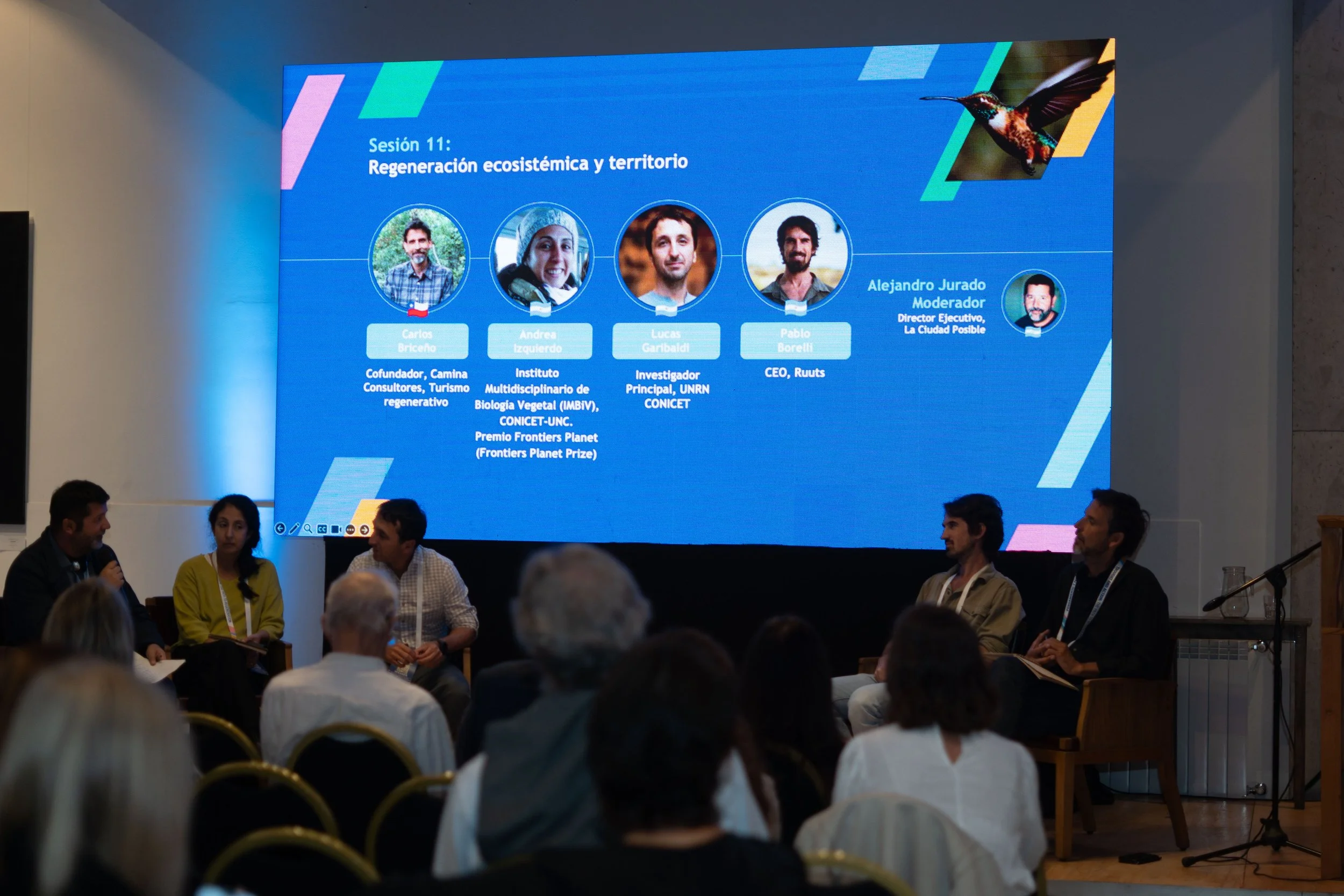
On the second day, themed From Reflection to Action: Regeneration as a Horizon, Dr Andrea E. Izquierdo, Frontiers Planet Prize 2026 National Champion for Argentina, joined a panel exploring agroecological and territorial management approaches and how they can transform production systems. Izquierdo was nominated by Multidisciplinary Institute of Plant Biology (IMBIV), CONICET, National University of Córdoba, Argentina, for consideration by the Argentine National Academy of Sciences to advance to Jury of 100 deliberation. Following this, Izquierdo and her team were recognised for their transformative research paper, Integrating local and Indigenous knowledge with Sustainable Development Goals in Lithium mining impact assessment for a fair energy transition, published in Environmental Science & Policy.
From the Salt Flats: When 'Green' Solutions Have Local Costs
Izquierdo's contribution centred on one of the most pressing tensions in the global energy transition: lithium mining in the Andean highlands. Decarbonising the global energy matrix through a shift from fossil fuels to renewables depends heavily on lithium, the core component of batteries. The most economically viable lithium reserves sit in the salt flats of Chile, Bolivia, and Argentina, in a region of environmental sensitivity, inhabited predominantly by indigenous and rural communities.
Placing this case study in the context of the proceedings, Izquierdo noted that ‘In the literal sense, mining cannot have regenerative practices. The brine pumped to extract lithium is a fossil resource, formed over millennia — it cannot regenerate, it will not recover.’ Yet, she argued that actions tending toward regeneration remain possible, and that the most foundational of these is rebuilding trust between communities and industry.
Bridging Local and Scientific Knowledge
Working alongside collaborators from the Stockholm Environment Institute (SEI) and colleagues from the National University of Jujuy and INBIB, Izquierdo's research followed three stages: a systematic review of impacts reported in the scientific literature; interviews with residents of four rural and indigenous communities across the three main lithium-producing provinces in Argentina (Jujuy, Catamarca, and Salta); and an analysis of how community-identified indicators align with the UN's Sustainable Development Goals framework.
The findings were striking. Science is largely reporting the same impacts that communities perceive, but local knowledge goes significantly further. As Izquierdo explained, community knowledge is far more comprehensive, richer and deeper. Local communities can make connections and analyses that are very rich compared to scientific knowledge, which tends to be more fragmented. Critically, this depth of understanding was consistent across communities with very different histories and relationships with mining.
The research makes a clear case: integrating indigenous and local knowledge, what participants at the conference evocatively called los pueblos de la tierra, "the peoples of the land," is not just an ethical obligation. It produces better science and better outcomes.
As the conference theme framed it: thought must lead to action. In Dr Izquierdo's work, that principle takes tangible form through regeneration rooted in trust, and in the knowledge of 'los pueblos de la tierra,' treated as its foundation. This sits at the core of what the conference and the Club of Rome's wider ethos affirm: that the crisis before us is civilisational as much as it is environmental. Building ‘collective, comprehensive and long-term responses’ begins with the recognition of humanity and the biosphere as a single, interdependent whole.
Read Dr Izquierdo's thought piece on lithium, local knowledge, and the energy transition here: Extractivism, Local and Indigenous Knowledge, and Justice: Rethinking the Energy Transition in the Andean Salt Flats
The Panel
The session, Ecosystemic Regeneration and Territory: Practical Cases, was moderated by Alejandro Jurado, Executive Director and Co-founder of La Ciudad Posible Latam, and featured:
Andrea E. Izquierdo, Multidisciplinary Institute of Plant Biology (IMBIV), CONICET, and the National University of Córdoba, Argentina
Carlos Briceño Fiebig, Co-founder and Director of Innovation, Camina Consultores / Global Initiative for Regenerative Tourism
Lucas Garibaldi, Principal Investigator, CONICET, and Director of the Institute of Research on Natural Resources, Agroecology and Development, Universidad Nacional de Río Negro
Pablo Borrelli, Co-Founder and CEO, Ruuts
Watch the full panel discussion below (in Spanish).