

The Frontiers Planet Prize at NYCW: Making Climate Futures Legible
On Wednesday 23 September 2026, the Frontiers Planet Prize joined New York Climate Week (NYCW) at Swissnex in Boston and New York. Connecting Switzerland and the world in education, research, innovation, and the arts; Swissnex Boston & New York hosted Assembly as part of a curated program of events. It was formulated to explore the role of deliberation and democracy in designing our climate futures. Contributors spoke to the ever-evolving process of constructing the stepping stones to our chosen destination through community engagement, large data projects, modelling, and partnerships.
One session, Visualizing Climate Worlds: Data, AI, and Immersive Futures, brought together a panel from three projects. Each uses data to make different systems visible, from global food and environmental systems, to patterns in city processes, and weather extremes for climate mitigation.
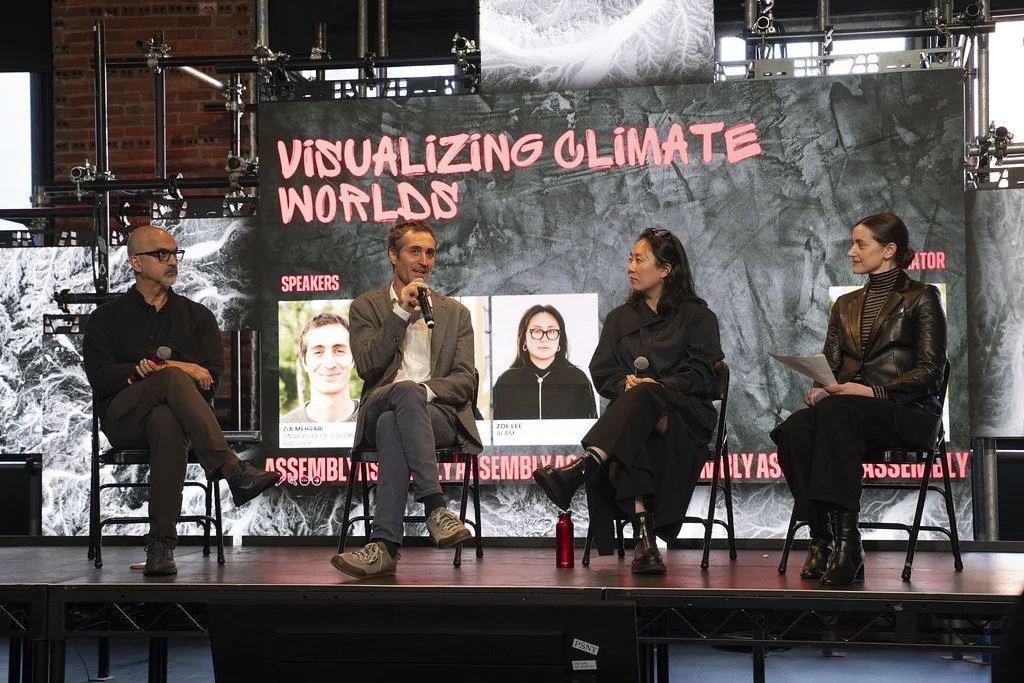
Visualizing Climate Worlds at Swissnex Boston & New York’s Assembly event. Panel from left to right: John E. Fernandez, Zia Mehrabi, Zoe Lee, and moderator, Lana Z Porter.
The Panel
John E Fernandez (Co-founder, MIT Environmental Research and Action)
Zoe Lee (Co-founder, BEAM)
Zia Mehrabi (Director, Better Planet Laboratory, University of Colorado Boulder)
Moderated by Lana Z Porter (Creative Director, Tractor Beam)
The Projects
John E. Fernandez: mapping the resource footprint of cities
John E. Fernandez is co-founder of MIT Environmental Research and Action (ERA). He and his team are building the Urban Metabolism Typological and Environmental Resource Assistant (UMTERA), a platform that sets the resource footprints of 11,000 cities side by side. It pairs Material Flow Accounting (MFA) with machine learning and AI to show, in fine detail, the materials and energy a city uses to function.
Zoe Lee: living in a flooded future
Zoe Lee, co-founder of BEAM, presented Tidelands 2100. This video game is set in a Rhode Island coastal community after nine inches of sea level rise. Its world is a 1:1 geospatial model of coastal Rhode Island, built from NOAA sea level rise projections, GIS mapping and field research across the region. The game draws on the infrastructure, ecology, industry and people of southern New England. It imagines how life might continue along the inland tide.
Zia Mehrabi: data products for a fairer planet
Zia Mehrabi directs the Better Planet Laboratory. Its data scientists and creatives build data products and services that address development challenges. The lab supplies partner organizations with the data they need to tackle food insecurity, biodiversity loss and climate change together. Their projects include:
WaterNet: a deep-learning model that tripled the known extent of the world’s mapped rivers. It was trained on US data, then used in Africa and Europe to find waterways missing from maps.
Global Food Twin: a “digital twin” of the global food system, launched in 2025 with Earth Genome. It follows food as it moves through major ports, roads, rail and shipping lanes, so policymakers can prepare for climate shocks.
Fenceline communities map: the highest-resolution map of communities exposed to fossil fuel extraction. Amnesty International used it as the basis for its Extraction Extinction report at COP30.
Zia won one of the three USD 1M International Champion prizes in the 3rd edition of the Frontiers Planet Prize. His team’s study, Joint Environmental and Social Benefits from Diversified Agriculture, involved more than 50 researchers and thousands of farmers in 11 countries across five continents. It provides the first cross-cultural evidence that diversified farming systems can cut environmental harm, strengthen rural livelihoods and help agriculture stay within planetary boundaries.
The Conversation
Swissnex pulled three takeaways from the panel: data is a tool, not an end in itself; local knowledge must sit alongside planetary data; and models don’t forecast the future, they help us decide which one to aim for.
Data serves a purpose. John Fernandez cautioned that “more information doesn’t make us wiser”. Data only helps when it has a framework and a clear goal behind it. Zia Mehrabi stressed that the data has to reach people who can act on it. In his words, “putting technology in a partner’s hand who’s already engaged in the development process can just accelerate their impact.”
Local knowledge fills the gaps. Satellite and planetary tracking data can’t capture everything. WaterNet began when Zia’s team found that half of the community requests for footbridges involved waterways missing from every existing map. Regional action on food, water and energy systems needs local input and planetary data working together.
Models help us choose. “The models will always be wrong,” Zia said. “It’s up to us to determine what future we want to live in.” Zoe Lee added that data can also shape how we tell the story of climate change. Tidelands 2100 pairs real climate projections with speculative fiction “to see how a new story might shape a new generation.”
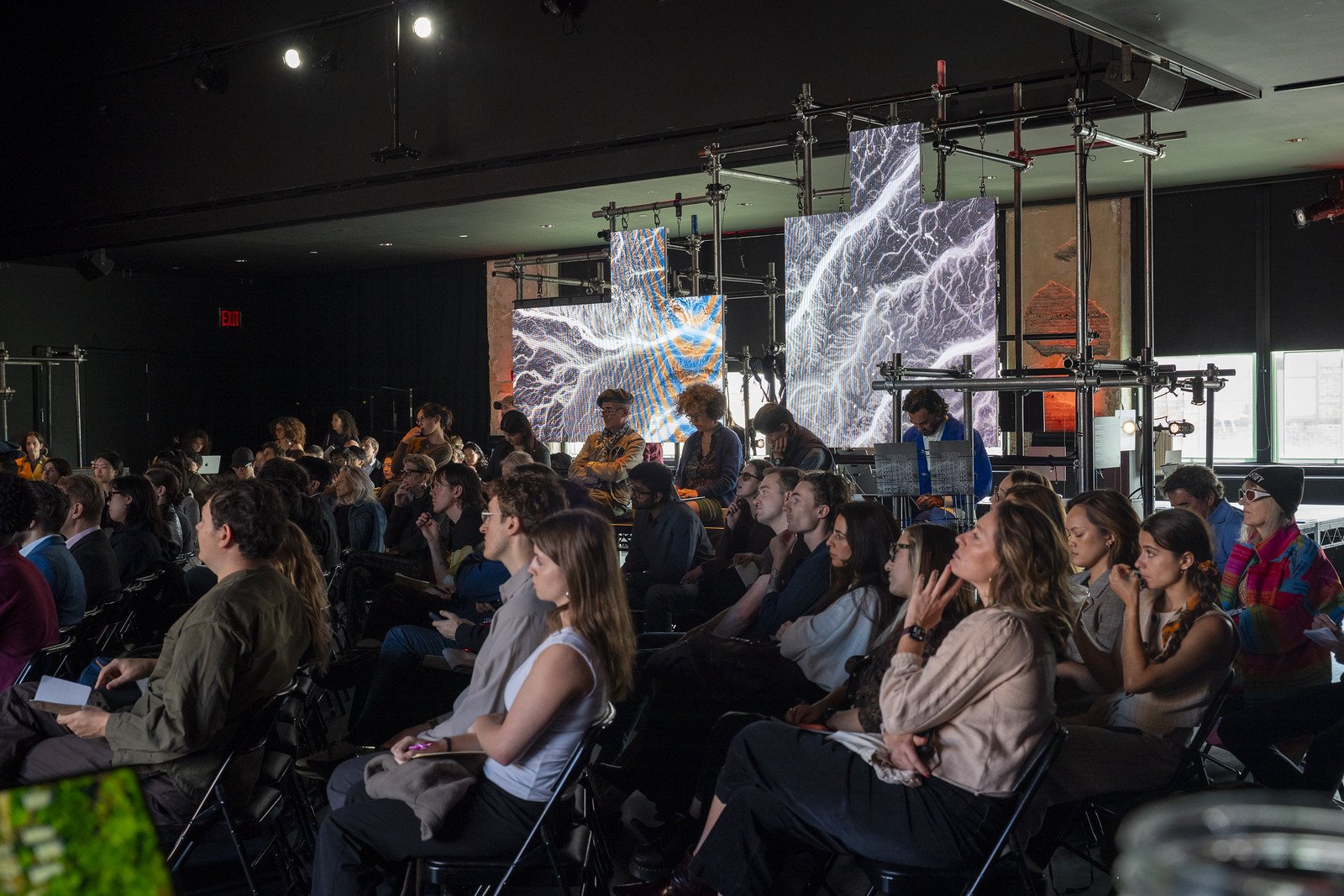
All images courtesy of Swissnex in Boston & New York.
To stay up to date with the Frontiers Planet Prize, follow us on LinkedIn.