

When the world’s scientific community gathers in one room, the future of global cooperation is on the table. At the International Science Council (ISC) Midterm Meeting and Beijing Science Dialogue, hosted by the Chinese Association for Science and Technology (CAST), leading researchers, business leaders, and philanthropists came together to chart a shared agenda for international science.
Over three days in October, more than 1,000 representatives from over 80 countries and regions came to Beijing for the ISC-CAST Beijing Science Dialogue. Researchers, business leaders and philanthropists had one aim: to set the agenda for international scientific cooperation at a moment when it is under strain.
Opening speakers made the case for science as a global public good, and the Dialogue ended with a concrete commitment: the Beijing Science Declaration, with 18 commitments to strengthen international scientific cooperation and shape science beyond 2030.
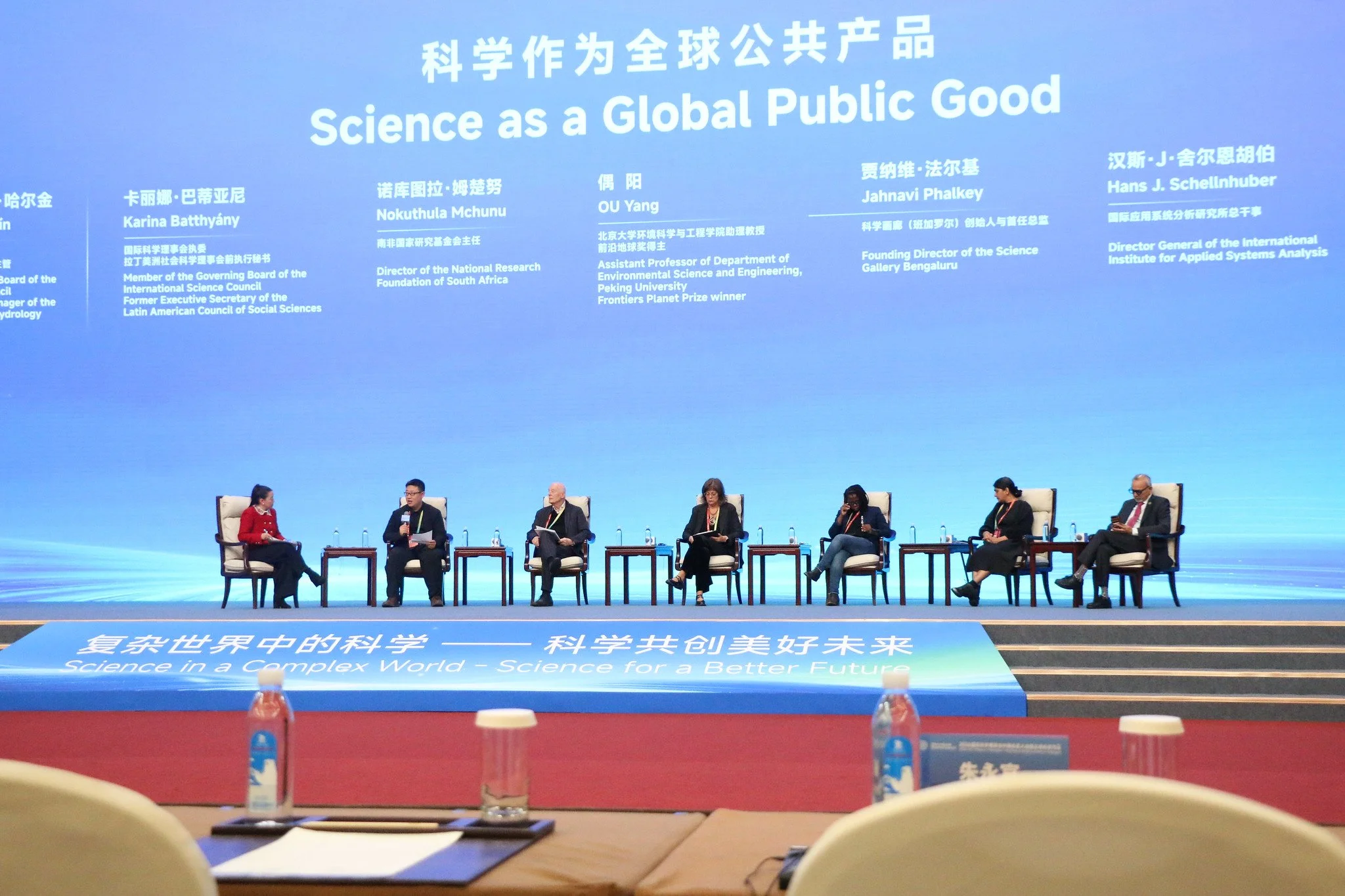
Yang Ou, 2nd Edition National Champion for China, at the ISC-CAST midterm meeting, speaking on the panel “Science as a Global Public Good.”
Day 1: Beijing Science Declaration Sets Priorities for Global Science
The Frontiers Planet Prize (FPP) was in the room from the start, with a workshop hosted with the ISC and CAST. Jean-Claude Burgelman, Director of the Prize, set out our mission: to advance scientific solutions to the planet’s most urgent environmental challenges. Representing China and the prize, champion scientists from previous editions then presented their winning research. The discussion turned to how universities and research institutions, national scientific bodies and an international jury can recognize research with the potential to change the planet for the better.
Day 2: Science in satellite symposia
On the second day the Dialogue spread out across the city into parallel satellite symposia. The programme set these alongside discussions of open science as a public good, recognition of diverse research contributions, responsible evaluation and community-governed infrastructures. Two members of the FPP community took part.
At the National Science Library, Jean-Claude joined the panel “Who governs open science? Perspectives across actors, disciplines and regions.” It asked how reform of scientific publishing and research assessment could help “reset” the system.
Across the Haidian district at Tsinghua University, Baojing Gu, 1st Edition International Champion for China, presented his research at the Future Earth and Climate Change Science Symposium. The symposium brought together ISC members, Future Earth and WCRP colleagues and leading research institutions to advance dialogue on earth system science and climate change.
Day 3: the plenary day
The final day moved to the China National Convention Center for plenary sessions on cross-cutting issues. The ISC framed these as urgent questions for science and policy, ending with the Beijing Declaration. FPP laureates sat on two of the three flagship panels.
Yang Ou, 2nd Edition National Champion for China, spoke on “Science as a Global Public Good.” The session asked how the ISC membership should respond to a knowledge landscape shaped by asymmetries between regions and institutions, by competition as well as collaboration, and by interlocking political, societal and technological forces. It also drew on the ISC’s emerging work on AI and science systems. The practical questions ranged from igniting new collaborative networks to sustaining observing and data infrastructures and governing shared resources across borders.
Later that afternoon, Xing Yuan, 3rd Edition National Champion for China, joined “Science, Society and Trust.” Science is becoming more specialized and more embedded in daily life, yet it can feel more distant from the public, and in some places trust in science is falling along with trust in public institutions. Framed by the ISC’s reading of the right to participate in and benefit from science, the session looked at practical ways to rebuild trust while safeguarding scientific freedom. It gave particular weight to science communication as a tool for openness and accountability.
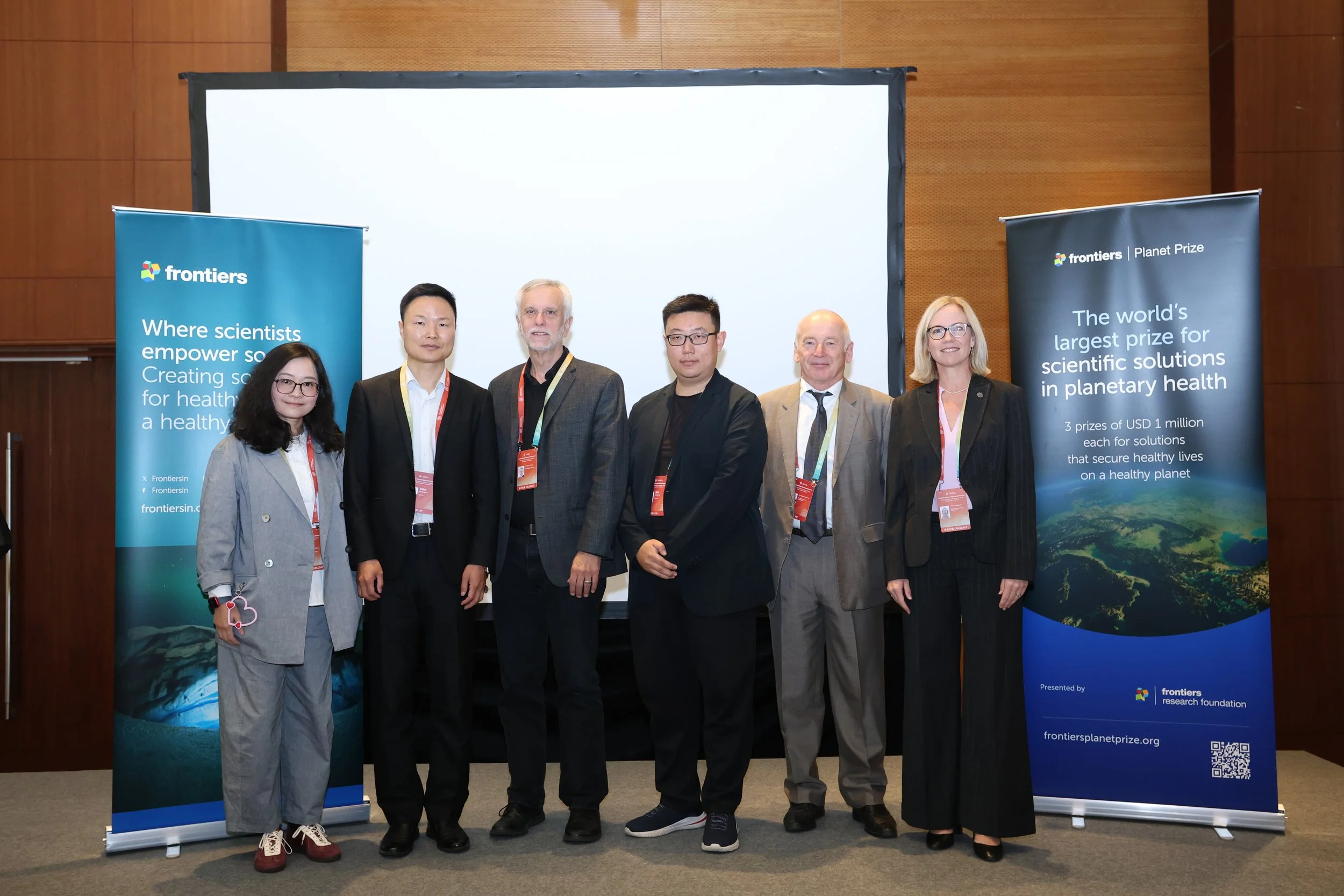
The Frontiers Planet Prize community at ISC-CAST midterm meeting 2026.
Closing and looking forward
Across three days in Beijing, the Frontiers Planet Prize community helped shape a dialogue about the future of global science. Our Champions spoke as members of teams, with research that has real impact beyond academia.
The event culminated in a commitment to the new Beijing Science Declaration, 18 commitments from scientific freedom, to responsible AI and public trust. Proceedings reaffirmed equitable involvement in science as a right, and a common endeavor of humanity. The Beijing Declaration puts open, trusted and collaborative science at the center of the global agenda. The Frontiers Planet Prize shares that aim: to recognize research that can change the planet for the better, and to help it reach the people who can act on it.