

Play and games for engagement with sustainability transitions

Dr Daniel Fernández Galeote
Tampere University
DOI: 10.25453/fpprize.32065929
Play, games, and gamification to support sustainability transitions: a scoping review and research agenda(Environmental Innovation and Societal Transitions, 2025)
“Play and games can be successfully embedded in real settings, support deep forms of learning, and facilitate real-world impact.”
At a time in which we have already crossed most planetary boundaries, it is crucial to abandon incumbent systems in favor of more sustainable ones if we are to advance towards a future where life on Earth can thrive. However, attaining sustainability is exceedingly challenging—it is not only a complex technical and ecological issue, but especially a social one. Indeed, sustainability transitions concern our diverse cultural understandings, beliefs, values, emotions, and identities. Even for those who agree with our current scientific knowledge and accept that a transition is necessary, the articulation of particular transitions at levels from local to supranational can be fraught with undesired features and consequences, leading to reasoned contestation. For example, mandatory regulations that do not consider the views of those affected can backfire—when political climates shift and these transitions are stopped or even reverted, those who fight for them are left with loss and frustration. Meanwhile, initiatives of, for, and by powerful actors that satisfy business-as-usual lifestyles and motivations fail to advance the radical transformations that could make a tangible difference in the lives of the majority and are thus viewed with suspicion.
Therefore, public engagement, including direct and plural participation in decision-making, but also a sense of cognitive, affective, and behavioral connection with environmental issues and solutions, is relevant for the equitable and democratic planning and implementation of transitions. In this context, play and games represent an opportunity to articulate engagement through systems that elicit positive emotional experiences ethically and enhance motivation towards learning and working towards better futures. By promoting a cultural change towards sustainability engagement across populations and practices, that is, in a systemic and embedded way, we can nurture other ways of living from the root of our motivations and relationships to others and life on Earth.
Yet, playful approaches are uncommon and do not receive as much attention and resources as other mechanisms. More fundamentally, we lack a systematic understanding of their current and possible role in sustainability transitions. This dearth of research exploring how engaging methods can support sustainability transitions is what motivated our study. Our interdisciplinary review and agenda aim to do justice to the complexity of our planetary crises while advancing our scientific understanding of joyful methods as a viable and desirable, but underexplored, response.
We analyzed 86 empirical studies on play, games, and gamification for sustainability transitions, resulting in an overview of state-of-the-art uses of these methods for learning, behavior change, and creative practice towards and as part of transitions. We found that most interventions did not address practices in their full complexity, nor did they engage large-scale issues directly, although inspirational examples of both exist. Furthermore, interventions tended to be successfully embedded in real settings, and multiple reported deep learning outcomes and direct real-world impact.
The actionable solution presented by this review is a framework to advance the research and practice of playful and gameful interventions to advance sustainability transitions. The three research agendas (contextual, design, and empirical) offer a blueprint towards the creation and commercialization of gameful solutions aimed at transforming practices and supporting large transition dynamics.
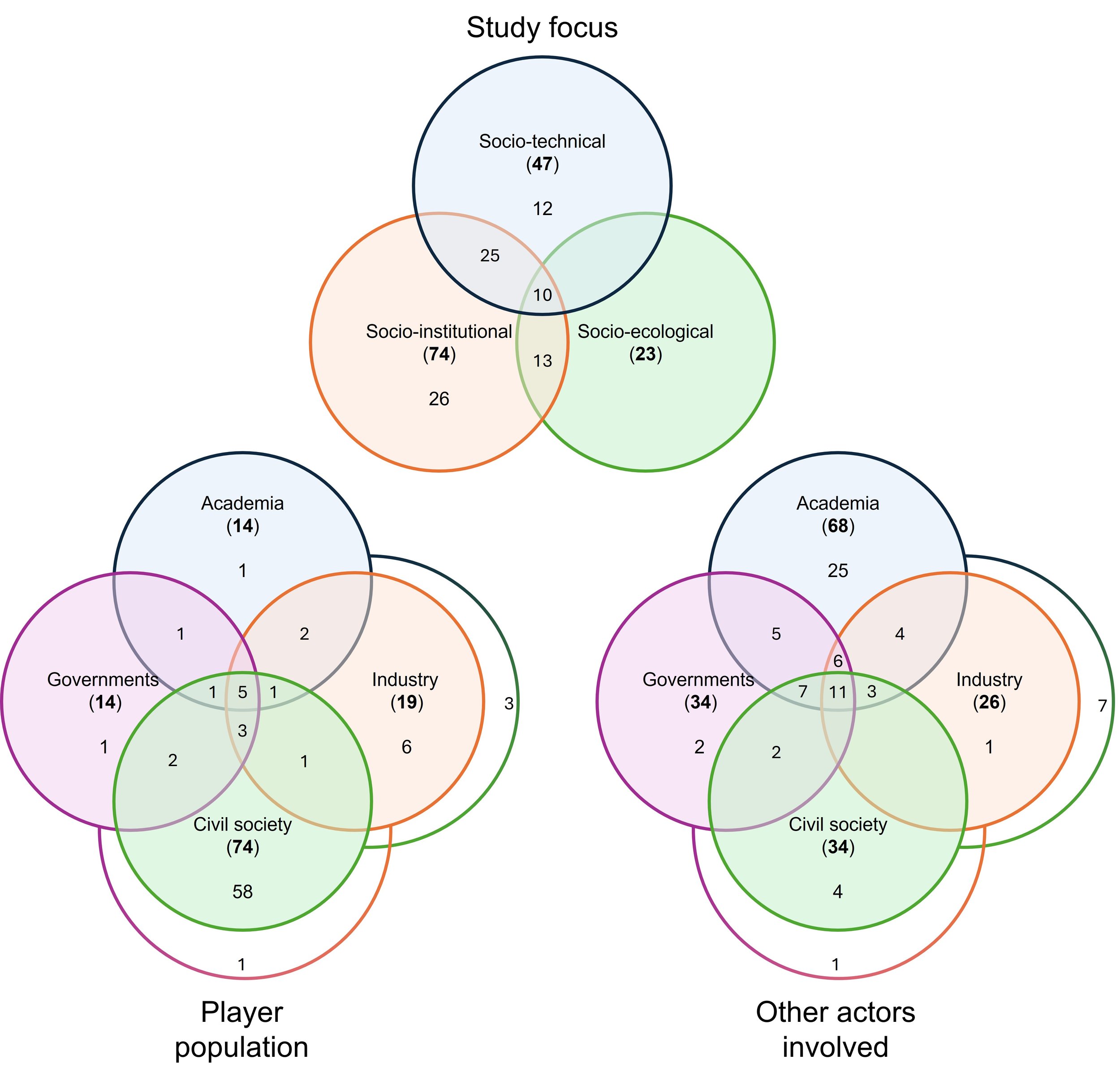
Figure 1. In the studies analyzed, the focus on socio-institutional aspects (i.e., institutional cultures, practices, agency, power…) prevails over socio-technical (infrastructure) and especially socio-ecological ones (resilience, tipping points, planetary boundaries). Interventions have citizens and civil society collectives as their primary target, although the involvement from academic actors, governments and industry are higher when more indirect roles are considered.
First, we offer recommendations towards improving the contextual fit of gamified interventions and research, advocating for a more explicit and critical integration of sustainability concepts; for involving more practitioners capable of implementing resilient transitions; and for considering players’ emotions. We also aim to increase the impact of gamification across systems and geographical contexts by suggesting that we embed play and games in socio-technical and socio-ecological transitions directly, around the globe, especially in currently underrepresented countries, and at larger scales.
Second, the review seeks to advance gamification design and implementation by calling for effective human-centered design strategies as well as more diverse designs and technologies. For example, we advocate for involving immersive media and leveraging pre-existing tools and techniques alongside gamified systems. And third, we advance empirical approaches to gamified ST by establishing connections with recommendations from ST research, play studies, and wider methodological and scientific concerns towards more rigorous and ambitious research designs and reporting.
Based on our findings and recommendations, we are exploring the creation and implementation of methods that may help various collectives imagine, implement, monitor and reflect upon transitions from daily life to larger systems. For example, we are conducting interactive workshops to help participants playfully experiment with their own lives towards more sustainable practices, and we are working on expanding these methods towards exploring and enacting systems change for professionals, future leaders and communities whose actions have impacts at a larger scale.
Beyond this, we hope that our research’s holistic view of engagement, rooted in playfulness, helps educators, designers, and researchers in this growing field in planning and conducting more effective and novel interventions. We also expect that our use of sustainability transition-specific lenses sheds light on the current state of gamification, not just as a tool for sustainability learning, persuasion, and behavior, but more broadly as a vehicle to advance transitions themselves, where much work is still needed to holistically transform practices and boost large-scale dynamics.
We have the capacity to create science-based, attractive, and accessible playful tools and experiences for effective use across settings and sectors, and to encourage local leaders and communities to create and implement their own for the engagement of diverse civic, academic, political, and industrial actors. The body of evidence gathered supports the implementation of initiatives at all policy levels, from educational, professional and civic institutions to transnational organizations with funding and political capacity. This advancement of new practices and policies aims to rethink and redesign the way in which societies confront the planetary issues we face, from anxiety and deprivation towards an engaged and creative way of understanding, feeling, acting, and relating.
For planetary boundary science in particular, the work provides a better understanding of success stories that show how we can explore together our current and future world, and what it truly means to live an engaged life towards and within a safe operating space of humanity. In other words, how we can mobilize active learning, creativity, and the arts as forms of being in the world and awaken dormant realities. Play and games, like other forms of art and engaging experiences, have shown their value for bringing complex scientific information to various audiences and contexts, not only simplifying but surfacing it and bringing it to life; to generate new data and knowledge through play; to combine different ways of knowing, involving emotion and direct experience more readily; to support communication between people and collectives with different worldviews; to empower participatory design, creation, and imagination through new ways of seeing and thinking; and to directly enact change via the exploration of new ways of living.
Through the above potentials, play, games, and gamification can help us advance towards a more complete vision of planetary boundaries, one that is informed by a transdisciplinary perspective that includes the social component of boundaries. Climate change and other ecological challenges are essentially human issues: Behind, or rather entangled with, every planetary boundary, we find people involved in many ways. Our research contributes to science by highlighting how we can have engaging and just transitions. Our task now is to advance towards even further understanding and application.
Figure 2: The research team in the field.