

The environmental and social opportunities of reducing sugar intake

Alon Shepon
Tel Aviv University
DOI: 10.25453/fpprize.32065944
The environmental and social opportunities of reducing sugar intake (PNAS, 2024)
“Sugar accounts for roughly a quarter of global agricultural production and carries substantial environmental and health implications.”
Food systems sit at the heart of both human well-being and planetary stability. Yet within these systems, certain crops play an outsized and often underexamined role. Our research focuses on one such crop: sugar. While sugar is commonly discussed in the context of health with a particular focus on obesity, diabetes, and other noncommunicable diseases, its environmental footprint and systemic implications receive far less attention. Sugarcane and sugar beet occupy vast areas of agricultural land worldwide, accounting for a quarter of all agricultural output by mass, and require significant inputs of water, fertilizers, and energy. As a result, sugar production contributes to greenhouse gas emissions, nutrient runoff, freshwater depletion, and land-use change. In a world already exceeding several planetary boundaries, the continued expansion of such a nutritionally non-essential commodity (Fig 1) raises profound sustainability questions.
Food systems account for a substantial share of global environmental pressures, driving deforestation, biodiversity loss, freshwater withdrawals, and disruption of nitrogen and phosphorus cycles. When a large fraction of agricultural output is devoted to producing a crop with limited nutritional value, the opportunity cost becomes clear. Sugar production should either be reduced or used more beneficially with higher social and environmental returns. Our research follows alternative futures for sugar through examining how reducing global sugar consumption could generate environmental and societal co-benefits while simultaneously improving public health outcomes.
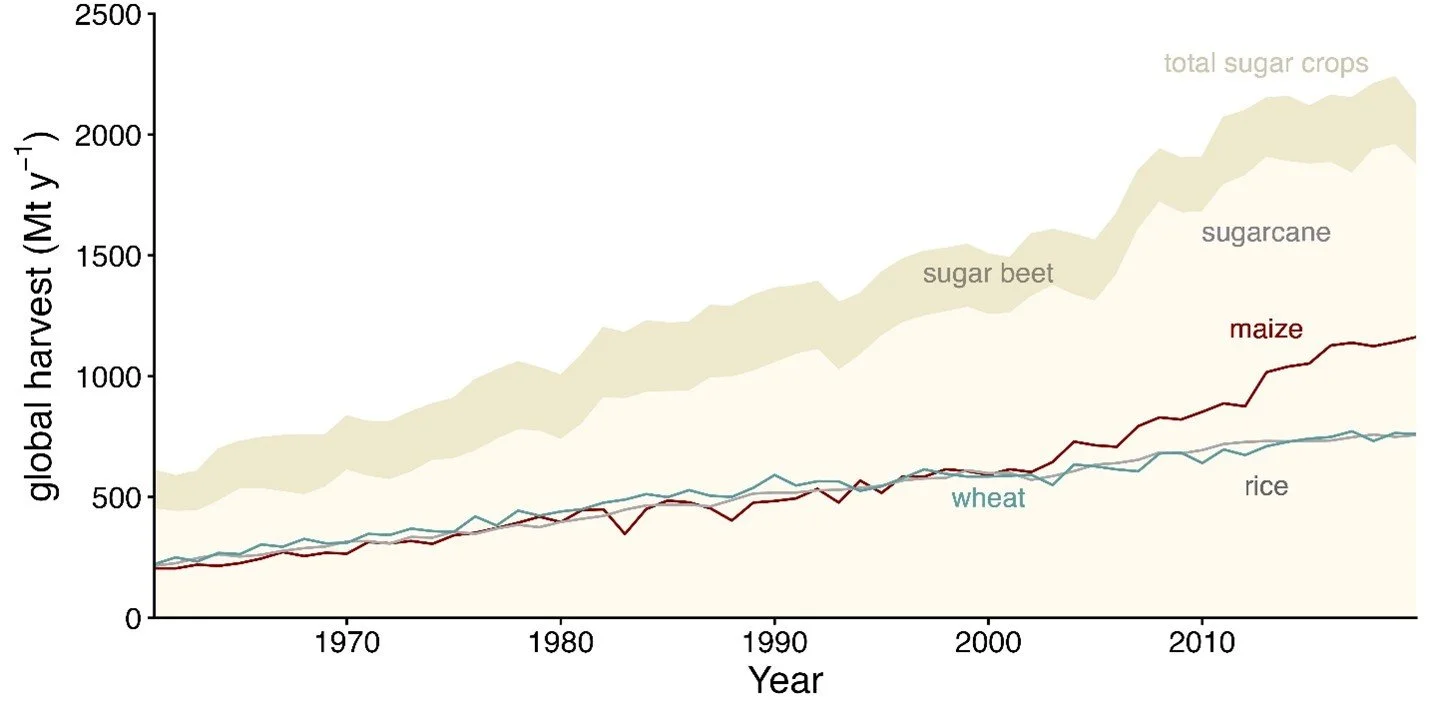
Figure 1. Sugar production and supply. Global harvest of sugarcane and sugar beet (stacked and collectively referred to as “sugar crops”) against major cereal crops and national supply per capita from 1960 to 2020.
Rather than framing sugar reduction as a purely individual dietary choice, we approach it as a systemic lever within the broader context of sustainable food transitions. Lowering excessive sugar consumption can spare lands that can be repurposed for other benefits such as growing nutritious crops or rewilding, better aligning with sustainability goals. Alternatively, production of sugar can maintain current levels but be stirred away from unhealthy consumption, with the excess sugar diverted to alternative uses such as bio-based plastic or microbial production of proteins. By modeling these scenarios, we show that relatively modest changes in consumption patterns can unlock disproportionate environmental and societal gains at scale.
Translating this insight into action requires coordinated efforts across sectors. Public health policies—such as sugar-sweetened beverage taxes, front-of-package labelling, and product reformulation standards—have demonstrated only a minor capacity to shift consumption patterns. We therefore argue that combining such demand-side policies with supply-side policies that give producers and policymakers more options can have greater political traction. For example, if sugar is redirected to alternative uses such as biofuel, bioplastic and protein, new economic opportunities will arise, spurring economic growth and new development. Industry actors can also play a role in such a transition if properly incentivized. Financial institutions and development agencies can further accelerate the transition by directing capital to these new opportunities. Another example can occur at the international level. Inspired by Just Energy Transition Partnerships, a sugar transition partnership, consisting of donor countries, can encourage a just transition of sugar-producing countries. For instance, it can provide a fund to cover the costs of the transition by supporting new infrastructure, training, R&D and compensating farmers when necessary.
Our work contributes not only specific policy-relevant insights but also a broader reframing of how dietary shifts intersect with Earth system processes. The planetary boundaries framework highlights the need to maintain climate stability, biosphere integrity, freshwater availability, and balanced nutrient cycles within safe limits. Sugar production intersects with many of these boundaries simultaneously. By quantifying how these different sugar futures could lower pressures on land systems and greenhouse gas emissions, our research identifies a practical and overlooked entry point for shifting food systems toward a safer operating space. It underscores that sustainability is not solely about technological innovation or supply-side efficiency, but also about reconsidering the allocation of agricultural resources in light of nutritional necessity and ecological limits.
This work integrates a neglected but important commodity into a wider academic discourse and policy conversations surrounding sustainable diets, going beyond individual health impacts. Connecting public health evidence with environmental systems modeling, it offers stakeholders a clearer picture of the multiple dividends that can arise from aligning dietary patterns with sustainability goals. Because sugar is deeply embedded in global trade and food manufacturing, shifts in demand can reverberate across supply chains, influencing production decisions worldwide. Our study contributes to a growing body of evidence that sustainable food system transformation is both necessary and achievable. By aligning diets, agricultural production, and policy frameworks, it becomes possible to reduce environmental pressures while promoting equitable and health-supportive food transitions—moving closer to a future in which Earth’s life-support systems remain within a safe operating space for generations to come.