

Constraints on low climate sensitivity models

Gunnar Myhre
CICERO Centre for International Climate Research
DOI: 10.25453/fpprize.32065917
Observed trend in Earth energy imbalance may provide a constraint for low climate sensitivity models(Science, 2025)
“Continued refinement of satellite-based constraints offers a promising pathway for reducing uncertainty in future warming projections and strengthening the scientific basis for climate policy.”
Future climate predictions carry substantial uncertainty, not only because future greenhouse gas emissions are unknown, but also because the amount of warming these gases ultimately produce remains uncertain. The warming response to increased greenhouse gas concentrations is commonly expressed as the equilibrium climate sensitivity (ECS), defined as the global mean temperature increase following a doubling of atmospheric CO₂. Uncertainty in ECS complicates both climate mitigation planning and climate adaptation strategies, as it directly affects projections of future warming and the severity of climate impacts. The Intergovernmental Panel on Climate Change (IPCC) Sixth Assessment Report (AR6) assesses the best estimate of ECS to be 3°C, with a very likely range of 2.0–5.0°C. This range reflects uncertainties in key processes such as changes to snow and sea-ice, cloud feedback, water vapour feedback, and changes in ocean heat uptake. A lower ECS would imply a more moderate warming trajectory for a given emissions pathway, whereas a higher ECS would point to more severe and rapid climate change. Narrowing the uncertainty in climate sensitivity, therefore, remains a central goal in climate science, with major implications for global climate policy.
Using long-term satellite observations, we show that climate models with low equilibrium climate sensitivity (ECS < 2.5 °C) fail to reproduce the observed top of the atmosphere energy balance trends. The Clouds and the Earth’s Radiant Energy System (CERES) instruments, operating since 2000, provide continuous measurements of the Earth’s Energy Imbalance (EEI), the difference between absorbed solar radiation and outgoing longwave radiation. Over the period 2001–2023, CERES data reveal that the planet has been absorbing more solar radiation and emitting more longwave energy than simulated by most climate models taking part of Coupled Model Intercomparison Project Phase 6 (CMIP6). The strong increase in absorbed solar radiation has been linked to multiple factors, including reductions in snow and sea ice; increases in atmospheric water vapour; cloud changes; a likely decline in aerosol concentrations; and a small increase in solar insolation.
Importantly, climate models with low climate sensitivity consistently fail to reproduce the observed combination of positive absorption of solar radiation and negative longwave EEI trends. The strongest deviation for the low climate sensitivity models compared to CERES is the absorption of solar radiation. The CERES record has already demonstrated substantial value in constraining climate sensitivity, and its continued use offers a promising pathway for narrowing uncertainties in future warming projections.
Progress in constraining climate sensitivity has historically been slow, owing to the complexity of cloud feedbacks, aerosol forcing, and long-term ocean heat uptake. Our study is the first to use both the shortwave and longwave components of the EEI from satellite observations to constrain climate sensitivity. This novel approach represents a significant methodological advance, as most previous observational constraints have relied on either global temperature changes or other observations. By explicitly incorporating satellite-derived EEI from CERES—capturing changes in absorbed solar radiation and outgoing longwave radiation—we demonstrate the strong potential of this method to substantially narrow the plausible range of climate sensitivity. The results challenge the credibility of climate models with low climate sensitivity, which consistently fail to reproduce the observed positive shortwave and negative longwave EEI trends. This mismatch suggests that the real climate system is more responsive to greenhouse gas forcing than such models imply.
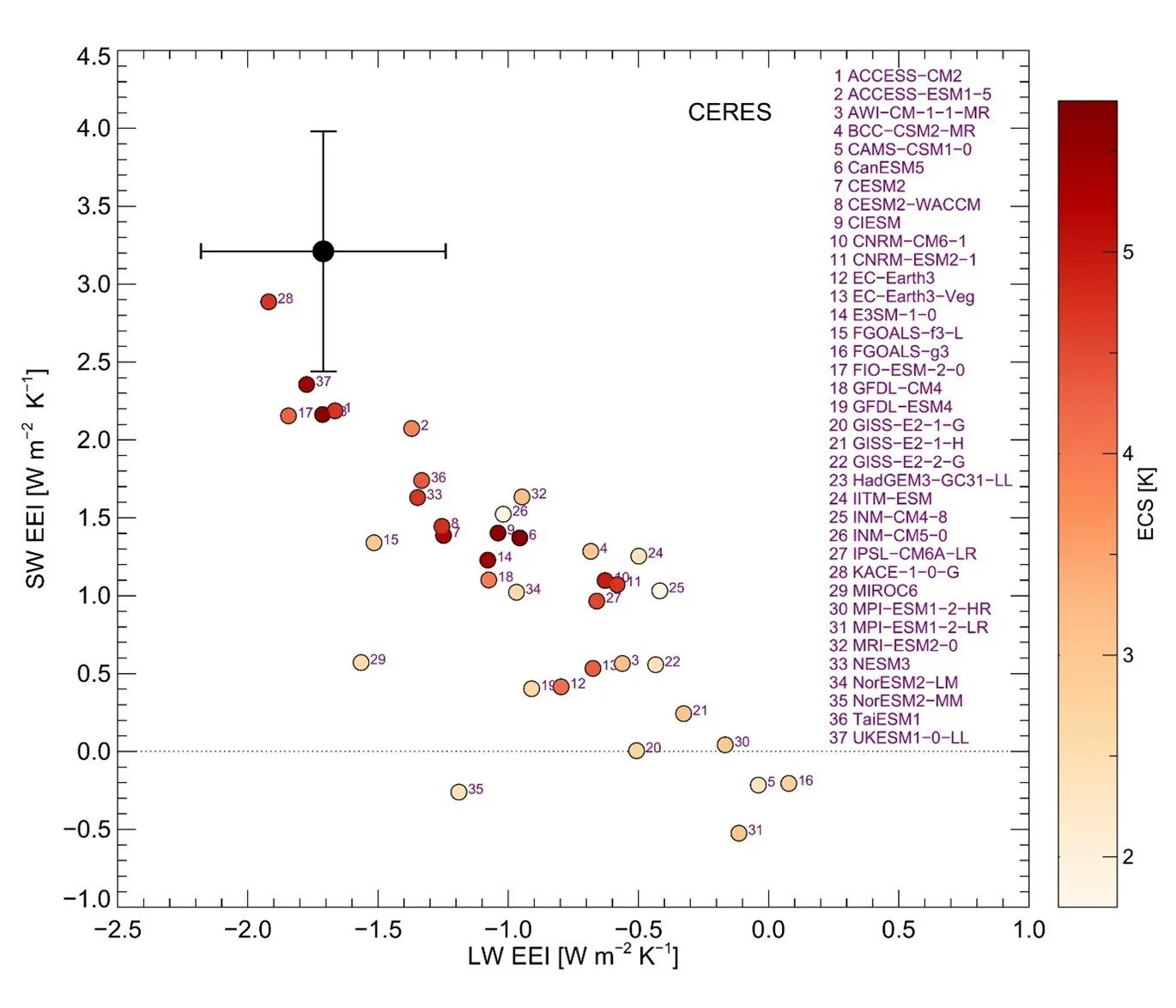
Figure 1: SW EEI per degree warming trends versus LW EEI trends per degree warming in CMIP6 models and CERES satellite data. Colors show climate sensitivity of each CMIP6 model. Lines around the CERES trends are 90% confidence intervals.
A more responsive climate to greenhouse gas increase has clear implications: if climate sensitivity is indeed higher than depicted by low sensitivity models, deeper and more rapid emission cuts will be required to limit warming to internationally agreed thresholds. Continued refinement of satellite-based constraints, therefore, offers a promising pathway for reducing uncertainty in future warming projections and strengthening the scientific basis for climate policy.
Our study focuses primarily on climate models with low equilibrium climate sensitivity, but it also shows that many high-sensitivity models compare favourably with the CERES satellite observations. This highlights the importance of examining not only the models that underestimate the observed trends, but also those that capture key features of the Earth’s Energy Imbalance. Understanding why several of the high-sensitivity models perform better in this context is crucial for improving future climate projections. At the same time, the possibility that the climate system is more sensitive to greenhouse gas forcing than some models suggest underscores the need for a precautionary approach. Given the substantial risks associated with higher climate sensitivity, a prudent response is to pursue rapid and deep reductions in greenhouse gas emissions.