

Satellite data can reliably estimate key forage quality indicators in drylands
Adama Lo
Centre de Suivi Écologique
DOI: 10.25453/fpprize.32065905
Remote sensing-based assessment of dry-season forage quality for improved rangeland management in Sahelian ecosystems(Rangeland Ecology & Management, 2024)
“Monitoring forage quality from space may seem a technical feat, but its real value lies in empowering communities, enhancing food security, and protecting the fragile ecosystems of the Sahel.”
Across the vast pastoral landscapes of the Sahel, pastoralism is more than an economic activity: it forms the backbone of livelihoods for millions of people and supports one of the largest concentrations of livestock on the African continent. In Senegal and throughout the Sahelian region, livestock systems rely almost entirely on natural pastures, which provide the bulk of animal feed. Yet, these already fragile ecosystems are increasingly under pressure. Climate variability, progressive soil degradation, and rapid population growth intensify the strain on pastoral resources, making sustainable management more urgent than ever. Ensuring the sustainability of these grazing systems is therefore not only a regional priority but also a global challenge linked to food security, ecosystem stability, and climate resilience.
The challenge facing Sahelian pastoral systems is not only the quantity of available forage but also, often even more critically, its nutritional quality. During the rainy season, vegetation grows rapidly, providing herds with abundant and nutrient-rich feed. Pastures green up, herbaceous plants renew, and animals have sufficient nutrition to maintain body condition and productivity. However, this favorable situation is short-lived. With the onset of the long dry season, which can last up to nine months in the Sahel, pastures undergo a slow but profound transformation. As plants mature, lignify, and dry out, their nutritional value declines. Protein content drops sharply while fiber content increases, making forage less digestible for livestock. Consequently, even when forage remains visible on the landscape, its capacity to meet animals’ nutritional needs diminishes significantly. This seasonal degradation of forage nutritional quality creates a silent yet persistent crisis in Sahelian pastoral systems.
While satellite technologies can already monitor forage quantity at large scales, information on forage nutritional quality, particularly during the critical dry season, remains limited. This lack of data can lead herders and livestock managers to make sub-optimal grazing decisions, increase animal stress, and reduce productivity. Without reliable monitoring tools, policymakers and pastoral communities struggle to anticipate feed shortages or identify areas of higher-quality forage, with major implications for food security, rural livelihoods, and ecosystem resilience in the Sahel. Addressing this knowledge gap is therefore essential for supporting sustainable land management and improving the resilience of pastoral systems under increasing climate pressure.
Our research addresses this challenge by developing an innovative method to continuously monitor forage quality from space, providing a practical, scalable, and cost-effective tool for sustainable pasture management and decision-making.
In this regard, we combined field measurements, laboratory analyses, and satellite observations to develop a system capable of estimating forage quality across expansive pastoral landscapes.
Our work focused on three key indicators of forage quality widely used in animal nutrition:
Crude Protein (CP), essential for growth and productivity;
Neutral Detergent Fiber (NDF), indicating total fiber content
Acid Detergent Fiber (ADF), related to digestibility.
These indicators were measured from forage samples collected in Senegalese pastures during the dry season. Using near-infrared spectroscopy (NIRS), a rapid laboratory method analyzing plant spectral signatures, we computed reliable estimates of forage composition.
Then, we linked these field measurements to satellite data from the European Sentinel-2 mission, part of the Copernicus Earth Observation Program. Sentinel-2 provides free high-resolution images with spectral bands particularly sensitive to vegetation properties, including shortwave infrared wavelengths that capture the biochemical characteristics of dry vegetation.
Through machine learning and statistical modeling, we identified satellite variables capable of predicting forage quality. Vegetation indices derived from Sentinel-2 imagery, such as the Green Residue Cover Index, chlorophyll absorption-based reflectance indices, proved particularly informative.
Calibrated models, with excellent predictive performance, allowed us to translate satellite observations into maps of forage nutritional quality, distinguishing between herbaceous vegetation and woody plant foliage, two key components of Sahelian pastures.
Using these models, we produced monthly maps of forage quality in Senegalese pastures, revealing significant spatial and temporal trends:
Forage quality progressively declines during the dry season.
Herbaceous vegetation rapidly loses nutritional value as plants dry and age.
Woody vegetation often retains higher protein levels, highlighting its importance as a resource for livestock during feed shortages.
These results confirm long-standing observations from herders: trees and shrubs are critical for livestock survival during scarcity periods. By mapping these dynamics regionally, our approach provides valuable information for multiple stakeholders.
For pastoral communities, such maps can support better grazing management, helping herders locate areas where forage quality remains relatively high. For governments and development agencies, the system could strengthen early-warning mechanisms for feed shortages and guide targeted interventions, such as livestock mobility planning or supplementary feeding. More broadly, this method can integrate into existing pasture monitoring platforms, enabling comprehensive assessments that combine both forage quantity and quality.
Leveraging open satellite data and scalable computing tools like Google Earth Engine, this cost-effective approach has strong potential to be deployed across the Sahel and other dryland regions worldwide, supporting large-scale monitoring of grazing ecosystems.
Our work contributes to this effort by providing a new tool for understanding and managing grazing ecosystems. By monitoring forage quality at large scales, satellite systems can help prevent overgrazing, promote appropriate pastoral mobility, and encourage sustainable vegetation use. These practices maintain ground cover, reduce soil degradation, and preserve biodiversity. Moreover, healthy pastures play a crucial role in carbon storage and climate regulation. Thus, improved management can mitigate climate change while strengthening pastoral community resilience.
In overall, advances in Earth observation and data science can directly support the transition toward more sustainable land management systems. And our research illustrates how combining local field knowledge with global satellite technology can generate practical solutions to some of the planet’s most urgent environmental challenges. Monitoring forage quality from space may seem a technical feat, but its real value lies in empowering communities, enhancing food security, and protecting the fragile ecosystems of the Sahel. Ultimately, such approaches help reconcile environmental sustainability with the livelihoods of pastoral populations, contributing to more resilient socio-ecological systems in a rapidly changing world.
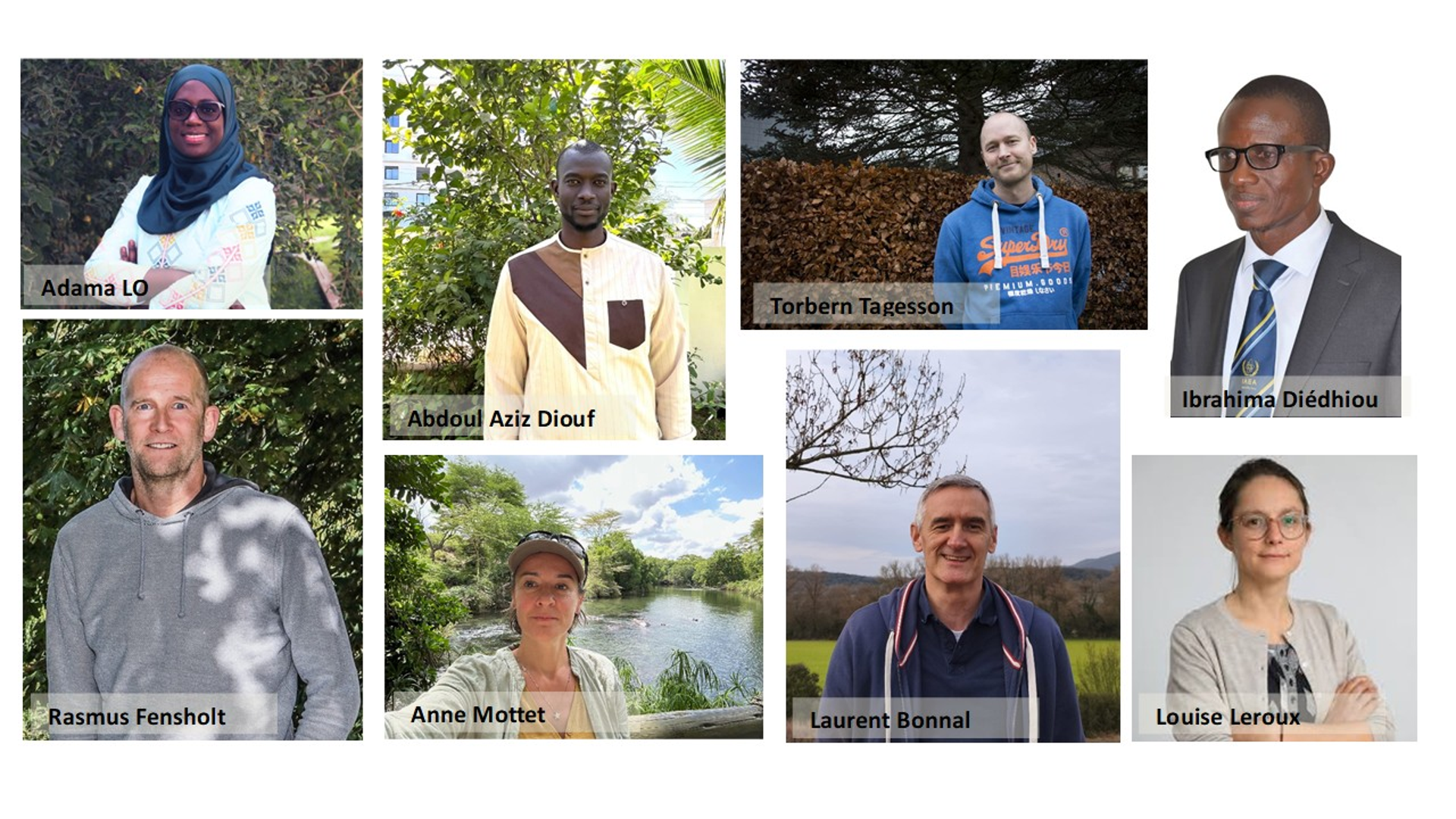
Figure 1: The research team.