

A convenient and reliable improvement to methane emission model for global landfills

Xunchang Fei
Nanyang Technological University
DOI: 10.25453/fpprize.32065896
Methane emissions from landfills differentially underestimated worldwide(Nature Sustainability, 2024)
“The Intergovernmental Panel on Climate Change’s model has been the gold standard for landfill methane emission estimation for decades. Our work improves by reconciling discrepancies between recent top-down and bottom-up measurements.”
Landfill methane (CH4) emissions account for between 10−20% of all anthropogenic CH4 emissions globally, amounting to ~50 Tg per year. Globally, CH4 emission from the solid waste management sector accounts for close to 5% of all anthropogenic and natural greenhouse gas emissions. Considering the obscure nature of the waste sector compared to other sectors under scrutiny, like power, transport, and building, the 5% contribution is astounding and traditionally overlooked. This value may even be underestimated due to the current emission model utilizing a one-size-fits-all first-order decay model recommended by the Intergovernmental Panel on Climate Change (IPCC). When compared to recent accurate top-down measurements using satellite remote sensing and airborne measurements, the mainstream bottom-up inventorial estimates exhibit significant biases. For example, a later article published in Science in 2024 using top-down measurements and inversion modelling found that ~47% of surveyed landfills in the United States showed higher emissions than their bottom-up estimates, with an average difference of 270%, while the other ~53% of surveyed landfills showed lower emissions than their bottom-up estimates or were non-detectable [1]. In other words, only very few landfills had consistent top-down measurements and bottom-up inventorial estimates. Such huge and prevalent discrepancies highlight the need for improvements in the IPCC model, which is indispensable for bottom-up estimation.
The classic IPCC model for landfill CH4 emission takes the form of:
Annual CH4 emission rate = total CH4 emission potential × k × e(−k × time),
where k is the a priori decay constant that influences the emission rate significantly. Traditionally, the k value is selected from a few default values based on country and waste composition. We improved the k value determination method by incorporating convenient compositional- and environmental-specific corrections, which are readily integrated into the established IPCC model. The accuracy of CH4 emission estimates is significantly improved by using the corrected k values, which have been benchmarked against the latest top-down measurements in the literature. Our work serves as a major improvement to the IPCC’s model, which has been rarely updated in the past few decades. Both the state-of-the-art top-down measurements and the improved bottom-up model contribute to the effective reconciliation of emission estimates of global landfills. Eventually, accurate emissions can be assigned to individual landfills to facilitate subsequent decision-making on management, mitigation, and post-closure development. Once a landfill is closed and redeveloped, it can be considered as being restored to natural status, contributing to returning Earth’s system to a safe operating space.
Our k determination method requires readily available inputs and is readily integrated into the IPCC’s model while maintaining its user-friendliness and simplicity. The next step would be to create an online and accessible platform for assessments of landfill emissions and mitigation strategies. The platform will empower site managers and policymakers, particularly in developing countries with economic and technical constraints on long-term landfill monitoring, to act strategically. Large emitters will be prioritized for mitigation, such as improving cover material, improving the gas collection system and planning, and transitioning from open dumping to sanitary landfilling. Reducing landfill CH4 emissions in developing countries with fast-growing waste generation but poor waste management often yields net negative or minimal marginal abatement costs at <US$1 per tonne of CO2-equivalent, making it one of the most cost-effective emission mitigation options in many countries. Zero- or low-cost CH4 mitigation measures in landfills could contribute optimistically up to 60 Tg per year of global CH4 emission reduction in 2030, which surpasses the potential reduction amount in the oil and gas sector at the same marginal cost.
Based on this work, we are jointly developing a research project with the International Methane Emissions Observatory team under the United Nations’ Environment Programme. The project aims to monitor and estimate landfill CH4 emissions in Southeast Asia, where measurements and estimates are scarce, and weather conditions often prevent top-down measurements and call for bottom-up monitoring and modelling. The joint research team hopes to establish a reconciliation framework for top-down and bottom-up results, which can be readily applicable to the Global South countries with little to no available field measurements and limited monitoring capabilities. This effort will mark another step towards global sustainable waste management.
From a public engagement perspective, our improved method has been incorporated by the Rocky Mountain Institute in the United States on its WasteMAP platform and waste sector modelling of Climate TRACE platform, both of which show landfill CH4 emission estimates for a large number of identified landfills globally. Both platforms offer global free access and intuitive visualization and user interface, while WasteMAP also provides a complementary decision-support tool for local waste management options. Therefore, our work contributes to providing a better and more intuitive understanding of landfill CH4 emissions to local officers and operators.
Solid waste management plays a pivotal role in ensuring a sustainable and equitable future, yet it has received disproportionally lower attention than some counterparts in environmental engineering, like wastewater treatment and air pollution control. Our findings highlight that landfills are at best grey boxes, if not black boxes, and much remains unstudied. This work serves as one of the few wake-up calls to the landfill CH4 emission problem, which has been cited by several highly impactful papers in the following years [2, 3]. The top-down measurements developed by other research groups [1−3] and bottom-up estimates improved in this work serve as two pillars to better understand and quantify global landfill CH4 emissions and improve sustainable waste management.

Fig. 1. Winning article co-authors, from left to right, Yao Wang, Mingliang Fang, Ziyang, Lou, Hongping He, Yuliang Guo, Xiaoqing Pi, Yijie Wang, Ke Yin, & Xunchang Fei.
References:
[1] Cusworth, D.H., Duren, R.M., Ayasse, A.K., Jiorle, R., Howell, K., Aubrey, A., Green, R.O., Eastwood, M.L., Chapman, J.W., Thorpe, A.K. and Heckler, J., 2024. Quantifying methane emissions from United States landfills. Science, 383(6690), pp.1499-1504.
[2] Dogniaux, M., Maasakkers, J.D., Girard, M., Jervis, D., McKeever, J., Schuit, B.J., Sharma, S., Lopez-Noreña, A., Varon, D.J. and Aben, I., 2025. Global satellite survey reveals uncertainty in landfill methane emissions. Nature, pp.1-6.
[3] Tong, H., Cheng, T., Li, X., Zhu, H., Ye, X., Fan, D. and Tang, T., 2025. Reduction of methane emissions through improved landfill management. Nature Climate Change, 15(8), pp.866-872.
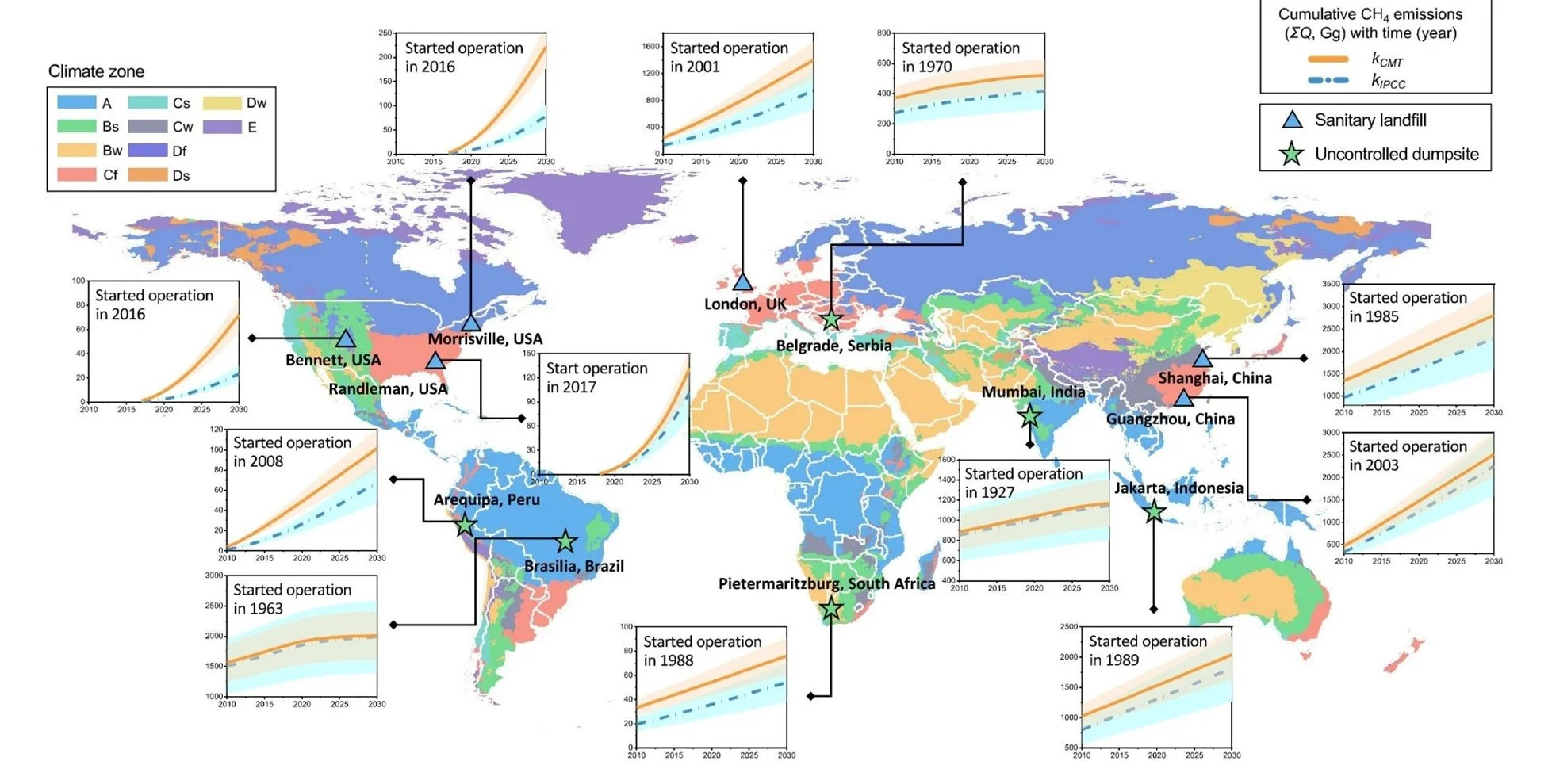
Fig. 2. Taken from Fig. 5 of the nominated paper: The predicted cumulative CH4 emissions since the beginning of operation to 2030 using our improved method and IPCC’s conventional method of 12 major sanitary landfills and open dumpsites worldwide.