

From Drought Anomalies to Actionable Water Risk

Amir AghaKouchak
University of California, Irvine
Xing Cheng
The Hong Kong Polytechnic University
Shuo Wang
The Hong Kong Polytechnic University
Jianli Chen
The Hong Kong Polytechnic University
DOI: 10.25453/fpprize.32065833
Global assessment and hotspots of lake drought (Communications Earth & Environment, 2025)
“We cannot prevent hazards from occurring, but through better science, we can help prevent them from becoming human disasters.”
Most drought monitoring and prediction systems still focus on anomalies, changes in precipitation, soil moisture, or related variables relative to historical normal conditions. These indicators are scientifically valuable, but they often stop short of what decision-makers most need to know: what will actually be impacted, where, and how severely. This creates a persistent disconnect between hazard and expected impact. A precipitation deficit does not automatically tell a reservoir operator whether municipal supply is at risk, a farmer whether irrigation water will be available, or a policymaker whether ecological collapse is imminent. For this reason, we need to move beyond conventional drought monitoring methods toward impact-oriented or decision-specific frameworks that better connect climate signals to societal consequences.
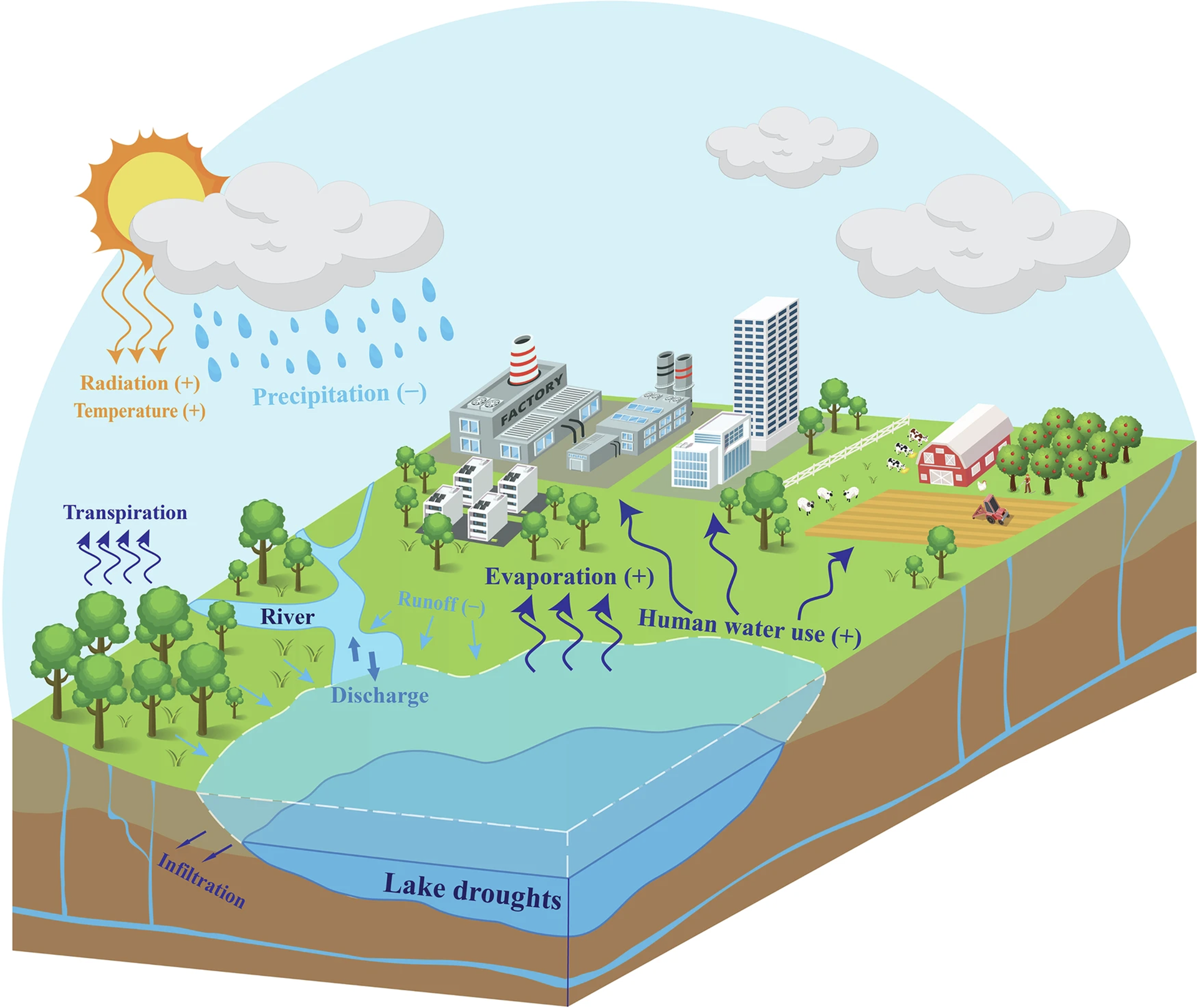
Figure 1. This diagram illustrates the complex water interactions between a lake, its surrounding land, and the atmosphere. Multiple variables connected to the lake water cycle are highlighted, including precipitation, temperature, evaporation, human water use, river discharge, runoff, infiltration, and transpiration. The arrows reflect the transport direction of these variables. The dotted line in the lake indicates the occurrence of a lake drought. The plus (+) or minus (−) symbols in brackets indicate an increase or decrease in the dominant variables resulting in lake droughts. For example, decreased precipitation (−) and increased evaporation (+) can lead to a lake drought.
One of the clearest places to make that shift is in lakes and water reservoirs. Across the world, many local decisions and management strategies are built around these water bodies because they are where climate variability becomes tangible. Cities depend on reservoirs for drinking water. Agricultural systems rely on lakes and reservoirs for irrigation. Hydropower generation depends on stored water, not simply on rainfall anomalies. Ecosystems, fisheries, tourism economies, and public health are all shaped by whether lake and reservoir levels remain within safe and functional ranges. Yet despite this practical centrality, drought science has historically paid more attention to deficits in climate variables than to extreme shortages in the water bodies people actually manage. Our research addresses that gap by reframing drought through the lens of lake drought (Figure 1). The critical problem our research addresses is the growing instability of freshwater systems under the combined pressure of climate change and human demand. Lakes and reservoirs hold most of the Earth’s accessible liquid freshwater and function as strategic buffers between climate variability and human need. When these systems experience extreme declines, the consequences cascade quickly across water supply, food systems, energy production, ecological health, and local economies. Until recently, however, there was no globally consistent framework for defining and assessing lake drought. That absence limited our collective ability to monitor freshwater stress in a way that is directly useful for policy and management.
Our work introduces a practical and scientifically robust definition of lake drought as periods when lake water availability falls below a critical threshold relative to seasonal normal conditions, making it unable to sustain normal ecological or societal functions. Using satellite-derived observations, we assessed more than 160,000 lakes worldwide from 1985 to 2018 and produced the first global picture of changing lake drought conditions (Figure 2). The results are sobering. Nearly 16% of global lakes show statistically significant increases in drought frequency, with particularly acute hotspots in the southern United States and southeastern Australia (Figure 2). These findings reveal that freshwater instability is not isolated or anecdotal. It is widespread, measurable, and growing. This matters today because lakes are not peripheral components of the Earth system. They are living infrastructure for society and ecosystems alike. When they fail, the impacts are immediate and often severe. The policy significance of this work lies in its ability to connect physical climate signals to actionable risk. Traditional drought indicators can tell us that conditions are dry. Lake drought tells us that water stored in the system itself is approaching or crossing dangerous thresholds. That is the kind of information that can support better reservoir operations, more adaptive water allocation, and earlier policy intervention. It shifts drought management from passive observation to forward-looking risk governance. In practical terms, this means water agencies can incorporate lake drought indicators into operational early-warning systems, municipalities can revise contingency planning before shortages become crises, and basin managers can use these signals to prioritize essential uses when water availability tightens.
Our research, therefore, offers several actionable solutions. First, it provides a framework for impact-based or decision-specific monitoring at regional to global scales. Satellite remote sensing now makes it possible to track changes in lake area and water availability with broad coverage and increasing timeliness. Integrating these observations into drought early-warning systems can help governments and civil society identify emerging hotspots before losses escalate. Second, the framework supports more climate-informed water management. Because lake drought is shaped by rising temperature, atmospheric dryness, precipitation deficits, evaporation, and human withdrawals, responses must be integrated rather than sectoral. Water allocation rules, reservoir operating curves, agricultural efficiency programs, and ecological protection strategies all need to be updated to reflect a future in which extremes are more frequent and more consequential. Third, the work is inherently scalable through partnerships with industry and civil society. Technology firms can incorporate lake drought indicators into climate risk analytics, digital twins, and infrastructure decision-support systems. Utilities and hydropower operators can use these indicators to stress-test supply reliability and plan for operational flexibility. Insurance and finance sectors can apply them in evaluating water-related risks to assets and supply chains. At the same time, civil society organizations can use transparent drought information to advocate for equitable water governance, especially in communities where shortages disproportionately affect vulnerable populations. In other words, this is not just a scientific metric. It is a bridge between Earth observation, public policy, and implementation.
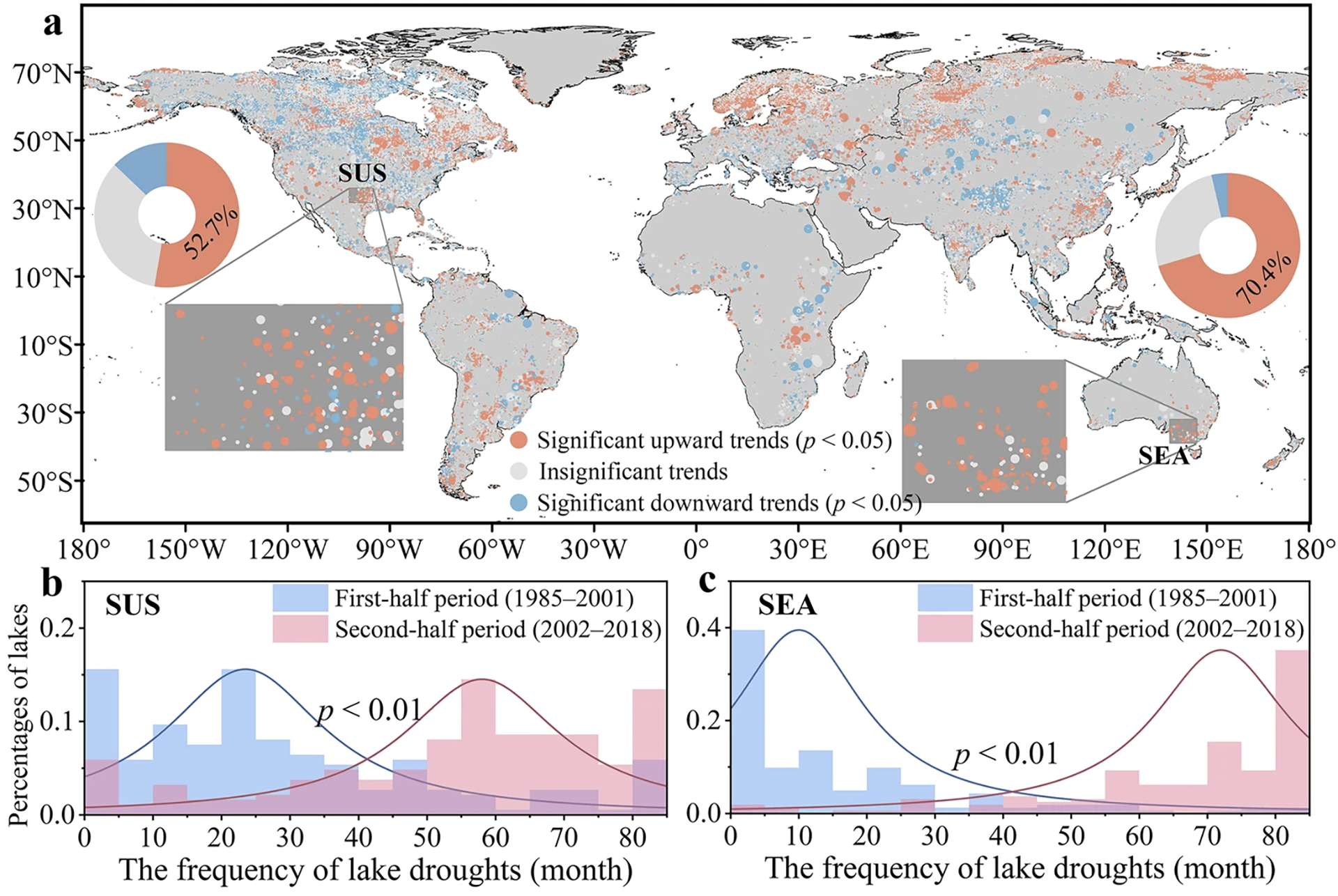
Figure 2. Global map of trends in the frequency of lake droughts, including significant upward trends (in orange), significant downward trends (in blue), and insignificant trends (in gray). Two hotspot regions are highlighted and zoomed in on the map. The pie charts indicate the percentages of lakes with different trends in the frequency of lake droughts in SUS and SEA, respectively. b, c Distribution of lakes with different frequencies of lake droughts (in months) during the first half (1985–2001) and the second half period (2002–2018) in SUS and SEA, respectively. The statistical significance levels (p-values) of the differences in these two distributions between the two time periods are provided.
The tangible impact of this research is already emerging in the way it reorients drought assessment toward stored freshwater, one of the most policy-relevant dimensions of water security. The framework provides an evidence base for embedding lakes and reservoirs into drought monitoring systems that have historically emphasized meteorological or soil-based indicators alone. It also helps explain why some droughts become socially and economically devastating: the hazard intensifies when it propagates into the water bodies that anchor local management decisions. At larger scales, the research is positioned to inform global water security assessments, adaptation planning, and transboundary dialogue in regions where shared lakes are central to cooperation and stability. Because lakes are monitored globally, the framework can be implemented widely and consistently, making it suitable for scaling across institutions and geographies. This work also advances planetary boundary science in a concrete way. The planetary boundaries framework reminds us that humanity can only thrive within a safe operating space defined by the stability of Earth’s core systems. Freshwater change is one of the most critical of those boundaries, yet it is often discussed abstractly. Lake drought offers a visible, measurable, and societally meaningful expression of freshwater boundary transgression. Increasing drought frequency in lakes signals that regional water cycles are losing resilience under higher temperatures, stronger evaporative demand, and unsustainable withdrawals. In that sense, lake drought is not merely a hydrological symptom. It is an Earth system warning signal that climate pressures are being translated into direct stress on freshwater storage, ecosystems, and human well-being.
Perhaps most importantly, the research points toward a pathway back to a safer operating space. Returning Earth’s systems to safer conditions will require more than describing anomalies. It will require decision frameworks that are tied to impacts, institutions that can act on early warnings, and investments that reduce exposure before a crisis unfolds. Impact-based drought intelligence can support more efficient water use, more resilient reservoir management, more responsible land and agricultural practices, and stronger cooperation across sectors and borders. Lake drought science can help governments and societies shift from reacting to water crises toward anticipating and reducing them. The larger vision is straightforward but urgent: we can no longer afford to monitor drought only as a departure from normal climate conditions. We must monitor it as a threat to the systems that sustain life, livelihoods, and ecological integrity. Lakes and reservoirs are where that threat becomes real for communities and decision-makers. By defining, detecting, and explaining lake drought at the global scale, our work helps close the gap between climate hazard and societal consequence. That is essential not only for better water management, but for a broader planetary transition toward resilience, justice, and a renewed safe operating space for humanity.