

News on the Frontiers Planet Prize

The Frontiers Planet Prize at the Falling Walls Science Summit 2025: Can science save the planet?
Since its launch in 2022, the Frontiers Planet Prize recognizes exceptional researchers whose breakthroughs safeguard healthy lives on a healthy planet, awarding 3 prizes of 1M USD per edition. This science is essential but not enough to keep us within the safe and just boundaries of our planet. How can we inspire action, amplify innovative science-based solutions, and push research further by mobilising scientists, funders, policymakers, and the private sector?
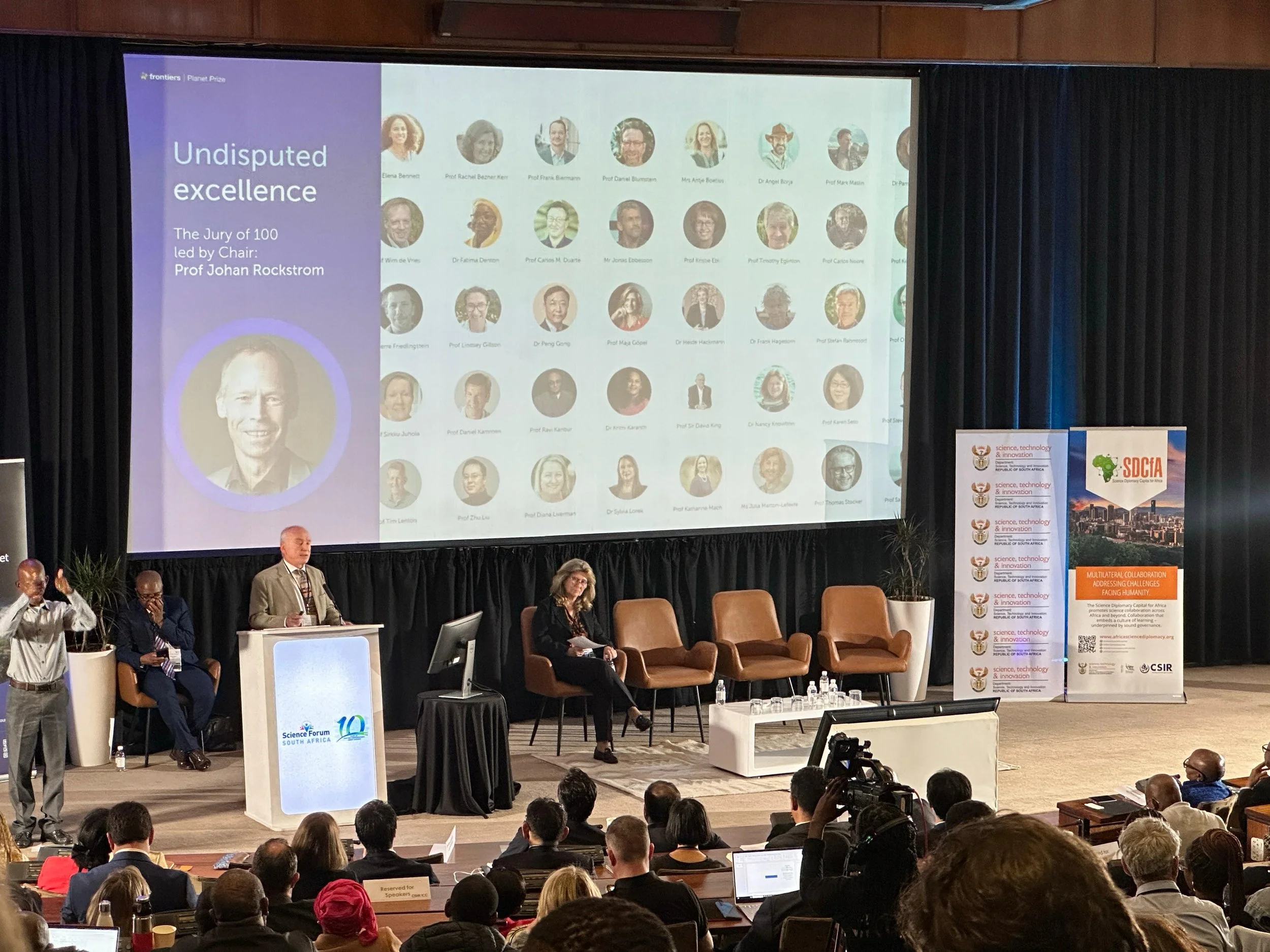
University World News: Science Forum outlines sovereign research agenda for Africa
Science Forum South Africa opened its 10th anniversary with a clear message: science must advance justice, support the continent’s leadership in shaping its own research priorities, and strengthen international collaboration. Frontier’s Planet Prize Director, Prof Burgelman, delivered a plenary address to 1,200 attendees.

Mongabay: Report identifies ten emerging tech solutions to enhance planetary health
Julian Reingold explores the 10 Emerging Technology Solutions for Planetary Health report, published by The World Economic Forum in collaboration with Frontiers.

The Frontiers Planet Prize at NSS: Scientific Consensus in Action
At the 2025 National Sustainability Society Conference, the session “The Frontiers Planet Prize: Scientific Consensus in Action” brought together leading researchers to discuss how science can drive transformative solutions for a just and sustainable future within a safe planetary operating space. The event celebrated the North American National Champions of the Frontiers Planet Prize.

Nature: These science prizes want to rival the Nobels: how do they compare?
Chris Simms, Nature News, examines the positioning of science prizes against the Nobel Prize, including valuable contributions from Frontiers Planet Prize International Champions Zahra Kalantari and Arunima Malik on recognising scientific excellence and highlighting gender disparities.

Mongabay: Ocean acidification threatens planetary health: Interview with Johan Rockström
Julian Reingold (Mongabay) speaks with Johan Rockström, co-author of the Planetary Health Check 2025 and leading Earth system scientist, on what the transgression of planetary boundaries means for environmental justice: the right of every human to a stable, healthy planet.

Future Earth: On Top of the World at Frontiers Planet Prize
“Attending the Frontiers Planet Prize 2025 in the mountain town of Villars-sur-Ollon, Switzerland, felt a bit like being on top of the world—literally and figuratively.” To delve into the science, insight and routes to transformation for the planet, read Future Earth’s article on our 2025 Award Ceremony here.

No Place to Hide: Our Only Choice for a Global Green Renaissance
A call to action from Jean-Claude Burgelman, Executive Director of the Frontiers Planet Prize.

The New Yorker: Is There Still Time to Be Hopeful About the Climate?
Daniel A. Gross, The New Yorker, speaks with Marina Romanello, 2025 National Champion for the UK and executive director of the Lancet Countdown, and Johan Rockstrom, leading Earth system scientist and Chair of the Jury of 100, about breaching the 1.5 degrees Celsius climate threshold and renewing global planetary health ambitions.

Frontiers Planet Prize Community Sessions: Assuming our collective responsibility for healthy lives on a healthy planet
Community sessions stimulated critical reflections and actionable insights aimed at enhancing the role of stakeholders in catalyzing transformative, globally inclusive, and solution-oriented science. The sessions were guided by three major objectives: bringing enough of the right science to the forefront, overcoming mounting skepticism on climate science and policy, and engaging stakeholders to mobilize resources for planetary boundary science.

Frontiers Planet Prize: Breakthrough systems thinking powering environmental futures
In an era defined by intertwined environmental and human health crises, we need bold, interdisciplinary and action-oriented knowledge leadership. Frontiers Planet Prize’s International Champions are leveraging systems thinking to illuminate the deep interconnections between human and environmental health, recognizing that challenges such as climate change, biodiversity loss and food insecurity cannot be solved in isolation.

Interview Of The Week: Jean-Claude Burgelman, Frontiers Planet Prize Director
Jean-Claude Burgelman is the director of the Frontiers Planet Prize, a global annual competition organized by the Frontiers Foundation, to bring actionable science to policy, industry and the public
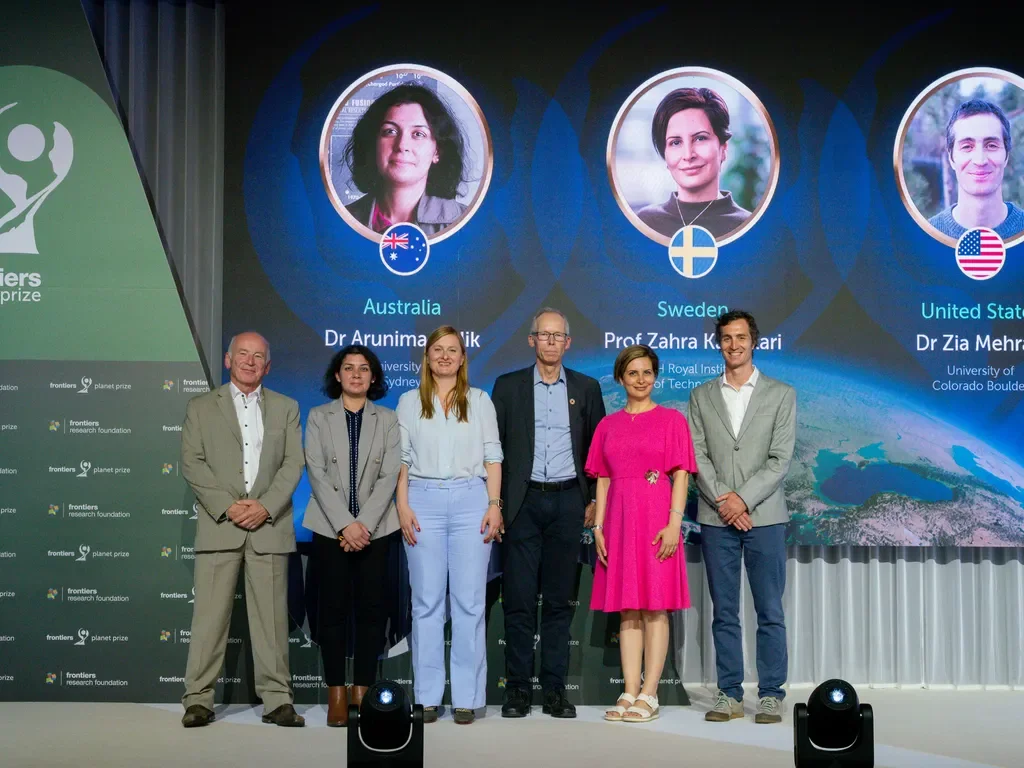
Science: For the first time, women scientists win $1 million climate research prize
Annika Inampudi, Science News, speaks to the International Champions of the 3rd Edition about highlighting women’s contributions to science and celebrating the collaborative efforts of research teams.

Celebrating the 2025 International Champions of the Frontiers Planet Prize
Meet the 3 International Champions of the 2025 Frontiers Planet Prize. Announced at our Award Ceremony on the 17th of June, 2025, these groundbreaking scientists have been awarded 1 million USD each to accelerate their breakthrough research.

Frontiers Planet Prize: The breakthrough science that could preserve our planet
The Frontiers Planet Prize rewards transformative scientific research to address environmental challenges. As the Earth faces up to a plethora of ecosystem threats, scientific study must evolve from innovation to action. To learn more about how Frontiers Planet Prize is mobilizing the scientific community, accelerating transformative solutions, and engaging the next generation, read this World Economic Forum article by Jean-Claude Burgelman and Lily Linke.

Powering climate action: Frontiers and the Frontiers Planet Prize push for adoption of open science solutions at San Francisco Climate Week
Frontiers and the Frontiers Research Foundation, in partnership with Swissnex, will host a high-impact event during San Francisco Climate Week titled “Achieving a Global Green Renaissance: Closing the Climate Implementation Gap with Breakthrough Research.” The event will bring together leading experts, innovators, and researchers to explore how open science and transformative research can accelerate solutions to the climate crisis.

Meet the Frontiers Planet Prize 2025 National Champions Driving Planetary Solutions
Meet the National Champions for Frontiers Planet Prize’s 3rd Edition.

Accelerating Flash Droughts in a Warming World
Xing Yuan from the Institute of Atmospheric Physics, Chinese Academy of Sciences, National Champion for China, shares pioneering insights from his research on flash droughts, rapid-onset drought events that intensify within weeks. His work provides the first global evidence that these droughts are increasing in frequency and speed due to human-driven climate change, with significant implications for water security, agriculture, and climate resilience planning.

Putting Human Health at the Centre of Climate Action
Marina Romanello from University College London, National Champion for the United Kingdom, represents the landmark Lancet Countdown on Health and Climate Change—a global collaboration spotlighting the profound health consequences of climate change. While climate narratives often center on ecosystems and infrastructure, her research repositions human health as the defining metric of climate failure and progress. Through 47 global indicators, the 2023 report reveals the escalating risks and presents comprehensive projections of future health impacts under worsening climate scenarios.

Rethinking Atoll Futures: Local Resilience to Global Challenges
Sebastian Steibl from the University of Auckland, National Champion for New Zealand, explores the existential vulnerability of atolls as powerful symbols of planetary boundary transgression. His research situates these island systems at the forefront of the climate crisis, using them as real-world case studies to illustrate the tangible consequences of breaching Earth's ecological limits—and the urgent need for global mitigation and adaptation strategies.