

Davos 2026: Reinventing 21st Century Cities with Science
Moderator: Jean-Claude Burgelman (Director, Frontiers Planet Prize)
Panel:
Bart Becks (Board Member, European Innovation Council)
Alice Charles (Director, Cities, Planning & Design, Arup and Board Member, Holcim Foundation)
Conradin Cramer (President of the Government of Basel-Stadt, Canton of Basel-Stadt, Switzerland)
Zahra Kalantari (Professor in Environmental Science and Engineering, KTH Royal Institute of Technology)
Cities are a major driver of planetary pressures, representing roughly 60–70% of the global population and up to 70–80% of economic activity. Echoing a warning from UN Secretary-General António Guterres, speakers highlighted the transformation of urban systems as a central part of the solution; “cities are where the climate battle will largely be won or lost.”
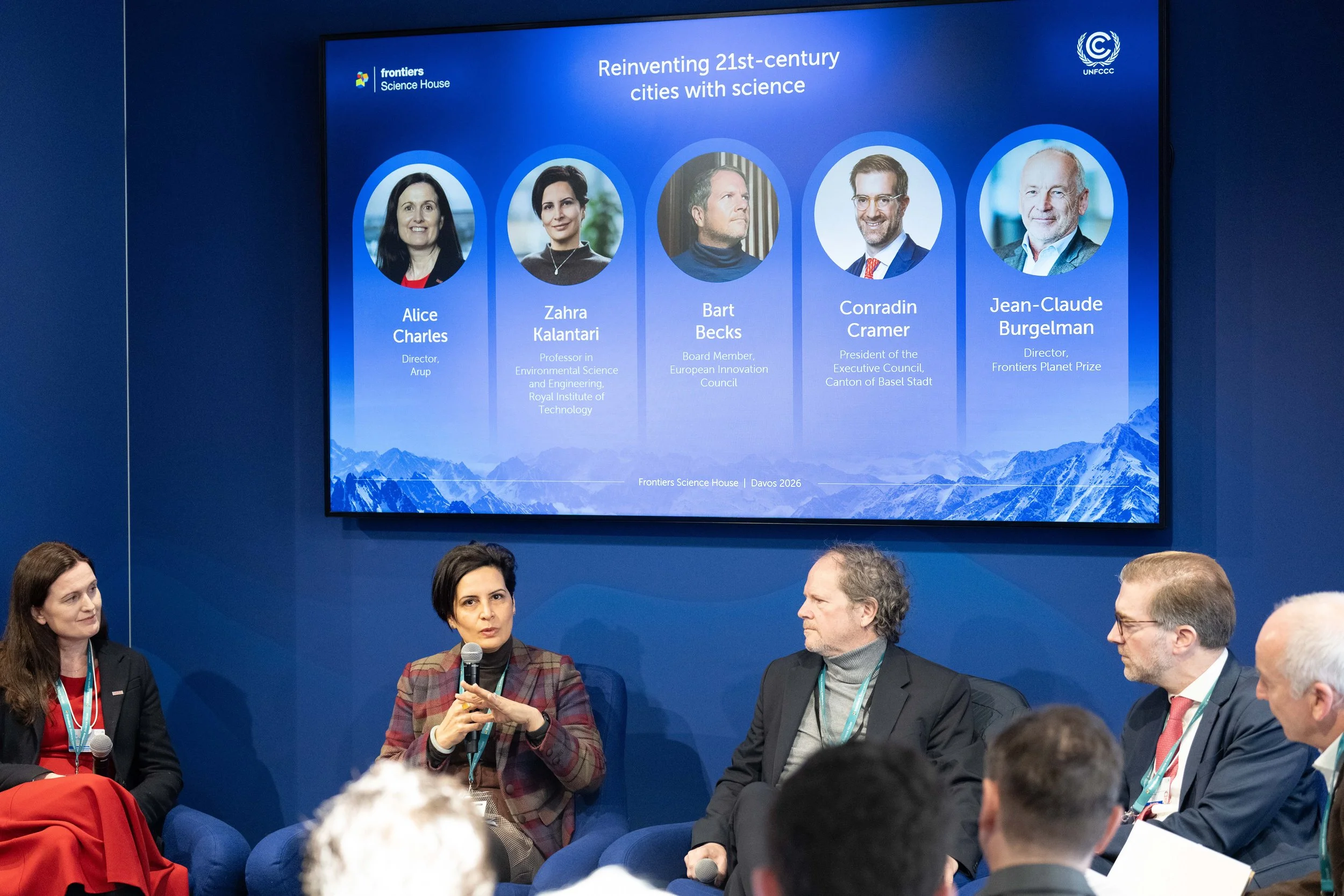
The panel discussed the complex interplay between science, technology and governance in building equity and longevity into the deployment of urban regeneration strategies. Zahra Kalantari, International Champion of the 3rd Edition of the Frontiers Planet Prize, opened the scientific segment of the discussion with an introduction to her award-winning research.
Kalantari and her team used digital modelling tools to assess the carbon mitigation potential of spatially prioritised Nature-based Solutions (NbS) across 54 European cities. Their analysis evaluated how these solutions could reduce emissions and help inform more effective urban governance strategies. To determine where NbS should be implemented, the researchers spatially allocated interventions according to two key factors. The first was the location of sectoral carbon emission sources within each city’s land-use grid. The second was the local context of each site, including socioeconomic characteristics, features of the built environment, and the broader land-use structure.
The poignancy of Kalantari’s approach underpinned discussions as the panel explored urban regeneration challenges. Alice Charles emphasised that cities must transform buildings, energy systems and transport networks while also pursuing more compact urban development, noting that urban sprawl contributes to increased emissions across multiple sectors. Bart Becks and Conradin Cramer outlined that effective urban transformation requires technology and governance systems that respond to the unique infrastructure and cultural context of the cities in which they are deployed. This becomes particularly evident when comparing European and American urban environments, where differences in road width and building density, for example, require distinct approaches. Kalantari’s methodology directly addresses these complexities by tailoring interventions to the specific spatial and socioeconomic realities of each city.
Tying in the role of governance, Cramer asserted that, while climate neutrality goals under his jurisdiction are compelled by public referendum, we cannot expect individuals to take the steps required to meet these goals without proper incentives. Political leadership must translate climate action into tangible improvements in daily life, such as cleaner air or quieter streets, to maintain public support for transformation.
Built into the conversation was the understanding that scientific solutions can, and must, benefit people and the planet. Urban regeneration across European cities, examined through work with C40 and partner organizations, shows how vacant industrial sites and unused buildings can be repurposed to address both emissions reduction and housing shortages. Charles pointed to the Earthshot Prize 2025 winner in the Clean Our Air category, the City of Bogotá, as a leading example of this kind of city transformation. Bogotá has pursued a long-term urban mobility strategy that prioritises walking, cycling, buses and integrated public transport systems, while also expanding green spaces across the city. These policies have helped reduce air pollution by around 24 per cent since 2018, while reshaping how nearly eight million residents move through and experience the city. Crucially, the deployment of this strategy has been sustained across successive political administrations.
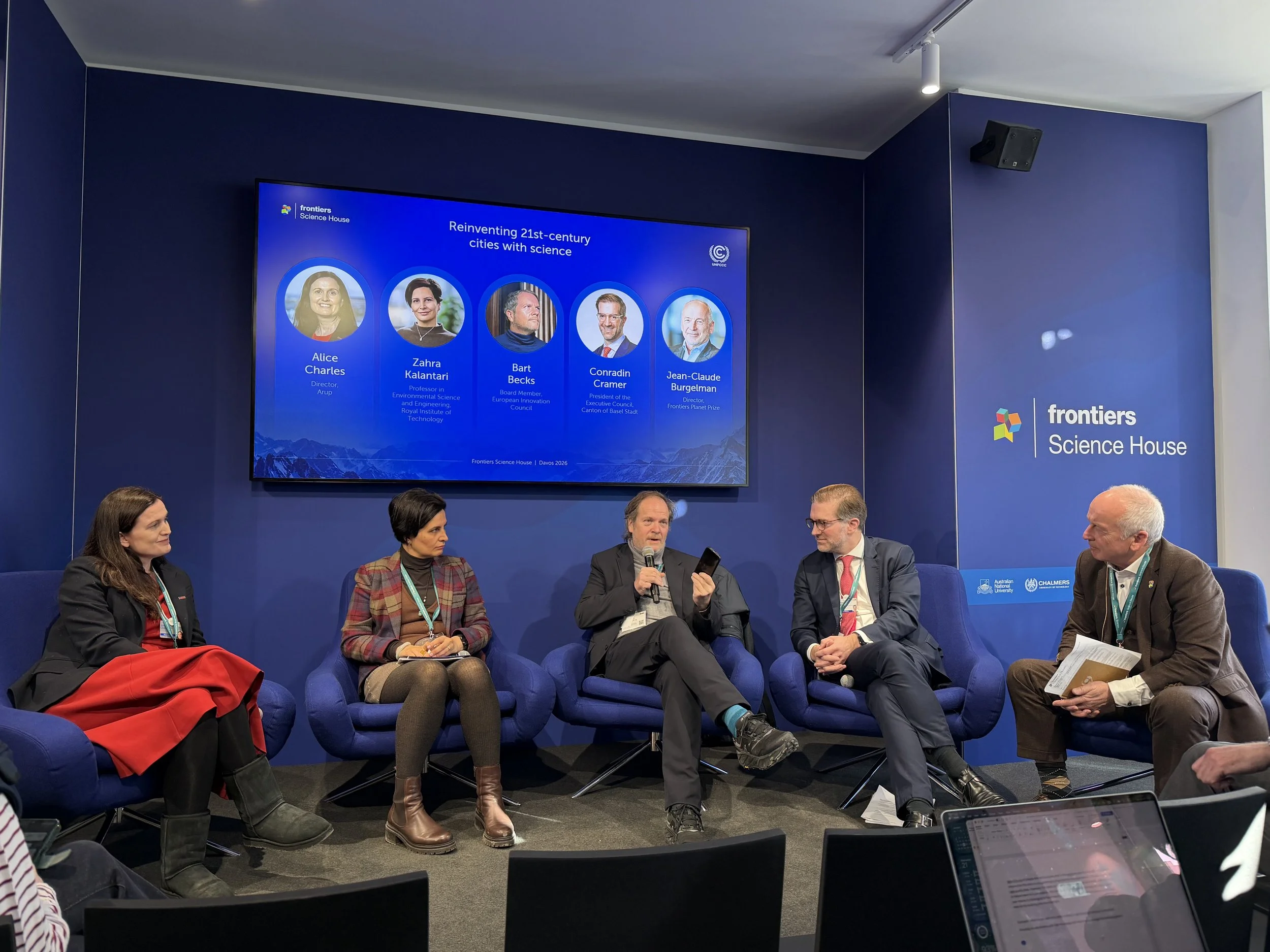
Drawing on robust science and real-world data to inform urban regeneration plans is essential for ensuring their longevity. However, panellists emphasised that alongside durability, cities must also act with urgency. Becks noted that artificial intelligence remains significantly underutilised in urban planning, despite its rapid adoption and transformative impact across many other sectors. The deployment of AI as a tool could accelerate the regeneration pathway for urban development.
This tool was termed a “city brain”, inspired by initiatives such as the Open Brain Institute, enabling shared knowledge which integrates urban data and best practices, pooled from multiple cities across the world. For this to be effective, Charles highlighted, the data used to inform urban decisions must be inclusive. Groups that are frequently overlooked in urban planning, including children, older people, disabled communities, refugees and women, must be reflected in the datasets used to guide infrastructure choices.
A “city brain” operating at hyperscale would require significant water and energy resources. Even when designed to support equitable knowledge and more tailored scientific guidance for climate solutions, such systems can carry substantial resource demands with cascading impacts. These impacts often fall disproportionately on the same marginalised communities that inclusive planning seeks to support, as well as contributing to environmental resource exploitation.
The role of science in generating solutions to reinvent 21st-century cities is well established. The pathway to implementation, however, is far more complex. Deploying urban solutions requires navigating a series of complex trade-offs at every stage, balancing environmental impact, economic priorities and human well-being, for healthy lives on a healthy planet. Yet major success stories already demonstrate the transformative potential of well-designed urban strategies. If cities are to become the places where the climate battle is ultimately won, robust science, accelerated knowledge sharing, and human-led governance must be central to shaping how they evolve.
Read more about the Frontiers Planet Prize at Frontiers Science House 2026 here.