

The Frontiers Planet Prize at Davos 2026
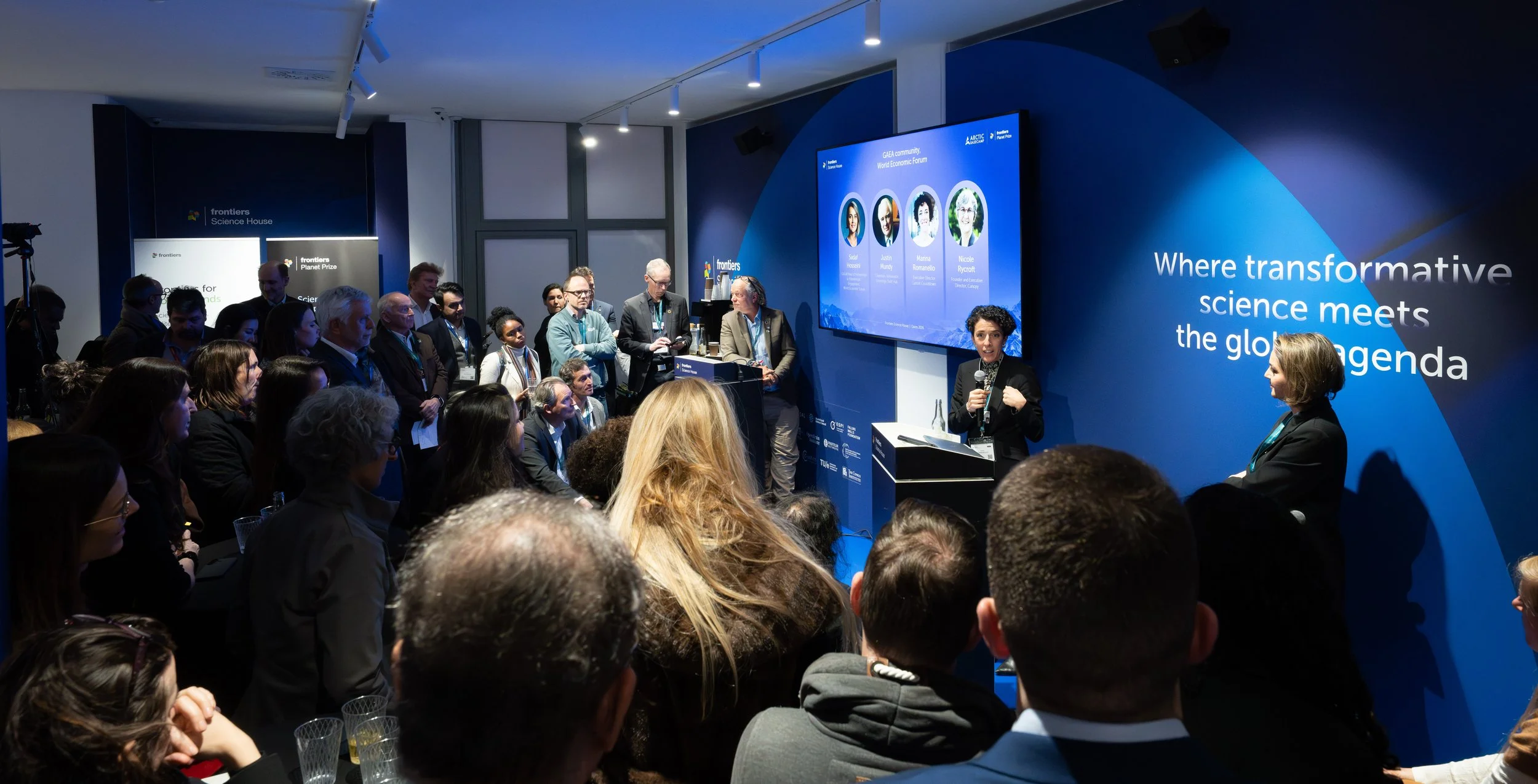
The World Economic Forum Annual Meeting is a landscape primed for activating innovative contributions to global change. This year, The Frontiers Science House established a new home for science dialogue. The proceedings carried the early momentum of a movement taking shape, with impactful discussions around key global issues, where transformative science took centre stage in shaping the pathways to the urgent solutions the world needs today.
On 21 January 2026, the Frontiers Planet Prize convened a dedicated afternoon programme focused on planetary health. The sessions brought together the Prize community and placed them with global thought leaders to celebrate scientific leadership and galvanize stakeholders of all disciplines into action.
Across the programme, conversations unfolded with a rare immediacy, spanning key topics from breakthroughs in zero-emission mobility to the risks and promises of geoengineering, from stabilizing plasma for fusion to the provocative question quietly circulating: is the Paris Agreement dead?
What made these exchanges distinct was not only their breadth, but the calibre and proximity of those shaping them. Presidents of leading institutions, CEOs of pioneering startups, and decision-makers from multilateral organisations engaged in candid, forward-looking dialogue: among them Laurence Tubiana, from the European Climate Foundation Robert-Jan Smits, former Director General at the European Commission, José Aschbacher, Director General of the European Space Agency, and astronaut Samantha Cristoforetti.
It was the kind of setting where disciplines dissolved, hierarchies softened, and ideas moved quickly from speculation to concrete action.
Reinventing 21st Century Cities with Science
Moderator: Jean-Claude Burgelman (Director, Frontiers Planet Prize)
Panel: Bart Becks (Board Member, European Innovation Council), Zahra Kalantari (Professor in Environmental Science and Engineering, KTH Royal Institute of Technology), Alice Charles (Director, Cities, Planning & Design, Arup and Board Member, Holcim Foundation), Conradin Cramer (President of the Government of Basel-Stadt, Canton of Basel-Stadt, Switzerland).
“If we’re going to use any form of technology, it’s to ensure that we meet the needs of people living in a city. Technology has got to be an enabler. And in the world of AI, we’ve got to ensure we have inclusive data. ”
To reinvent 21st-century cities through science, panellists emphasised the need for stronger and more dynamic knowledge exchange across science, technology, urban planning and governance as the foundation for cities to thrive. This collaboration can help embed urban regeneration strategies as enduring frameworks that remain stable despite changes in political leadership. These strategies must be informed by comprehensive data, strengthened both through the expansion of Open Science and through the meaningful inclusion of perspectives from underrepresented groups. Panellists also stressed that urban regeneration plans cannot simply be scaled and replicated across cities. Each approach must respond to the specific social, environmental and infrastructural context of the city in which it will be implemented. Artificial intelligence can support this process by analysing complex datasets and informing planning decisions. However, it should remain an enabling tool rather than a driver of policy, with human judgment and responsive governance putting core human needs at the centre of the decision-making process, guiding how cities evolve. Read more about this panel here.
How the World’s Most Groundbreaking Science Can Accelerate Transformation
Moderator: Johan Rockström (Director, Potsdam Institute for Climate Impact Research, Frontiers Planet Prize, Chair of Jury of 100)
Panel, Frontiers Planet Prize International Champions 2025: Arunima Malik (Professor, University of Sydney), Zahra Kalantari (Professor in Environmental Science and Engineering, KTH Royal Institute of Technology), Zia Mehrabi (Director, Better Planet Laboratory)
“The positive story is that we have solutions that can lead to change, re-envisioning our agricultural landscapes to function in a way that is more in harmony with nature. ”
The discussion explored how cutting-edge, transformative research can accelerate solutions to planetary challenges. The Planetary Boundaries framework was highlighted as a scientific guide for maintaining Earth system stability, with assessments showing that seven of the nine boundaries have already been crossed. Speakers presented examples of science moving from diagnosis to practical transformation. Zia Mehrabi demonstrated how diversified farming systems can enhance biodiversity and food security without reducing yields. Arunima Malik showed how global supply-chain analysis reveals environmental impacts embedded in international trade. Zahra Kalantari highlighted how strategically deployed urban nature-based solutions can significantly reduce emissions. Panellists emphasised that scientific breakthroughs only deliver impact when translated into practical tools, interdisciplinary collaboration and scalable policy solutions. Read more about this panel here.
Arctic Basecamp and the Frontiers Planet Prize: Science at the Decision Table
Speakers: Wolfgang Oels (COO, Ecosia), Daniel Erasmus (Founder / Member, ClimateGPT / The Club of Rome), Sadaf Hosseini (Global Head of Partnerships & Philanthropic Engagement, World Economic Forum), Gail Whiteman (Inaugural Hoffmann Impact Professor for Accelerating Action on Nature & Climate, University of Exeter Business School), Johan Rockström (Director, Potsdam Institute for Climate Impact Research, Chair of Jury of 100), Jean-Claude Burgelman (Director, Frontiers Planet Prize)
Including the Frontiers Planet Prize 3rd Edition International Champions: Arunima Malik (Professor, University of Sydney), Zahra Kalantari (Professor in Environmental Science and Engineering, Royal Institute of Technology), Zia Mehrabi (Director, Better Planet Laboratory)
And the 2025 GAEA winners: Justin Mundy (Chairman, Sustainable Sovereign Debt Hub), Marina Romanello (Executive Director, Lancet Countdown), Nicole Rycroft (Founder and Executive Director, Canopy)
“Climate change is not a problem of polar bears in the year 2100. It’s a problem for us today. It’s impacting our health, well-being, and future. ”
The celebration highlighted how science can be brought closer to global decision-making through initiatives that connect researchers with leaders across sectors. Arctic Basecamp was founded to “speak science to power,” bringing scientists into direct dialogue with policymakers, business leaders and civil society during the World Economic Forum Annual Meeting in Davos. What began as a small scientific tent has grown into a recognised platform for communicating climate risks, marking its 10th anniversary at the Frontiers Science House. The event also celebrated researchers recognised through the Frontiers Planet Prize and the GAEA Award, highlighting a shared mission: ensuring that credible science informs global decisions, paving the way for real-world impact that benefits people and planet. Together, these initiatives illustrate how discovery, innovation and science communication can work in tandem. Winning researchers noted that recognition through the Frontiers Planet Prize has increased the visibility of their work, opening new collaborations with cities, businesses and academic institutions. Speakers emphasised that transforming evidence-based knowledge into compelling narratives focused on solutions is essential for bridging the gap between research and action.
Lasting impact
Science is defined by continuous innovation and has long been the catalyst for era-defining discoveries and societal progress in tackling global challenges. The Frontiers Planet Prize champions are pioneers in their fields, delivering innovative, transformative research with tangible solutions to the planetary crisis. But breakthrough research only changes the world when it is matched by political will and sustained investment. At the Frontiers Science House, scientists leading in their fields were given the same standing as representatives of established industries, engaging directly with leaders across governance, finance, technology and civil society. What emerged was not just alignment, but momentum.
Speakers reinforced trust in science as a constant, emphasising its role in informing enduring frameworks that remain stable even amid geopolitical uncertainty, underpinning economic stability, human wellbeing and planetary resilience. These frameworks must be grounded in comprehensive data and strengthened through the continued expansion of open science. Crucially, science must also be action-focused and transformative, moving beyond insight to drive real-world change at speed and scale. The way we communicate must also evolve to meet the urgency of the planetary crisis. The solutions are no longer a matter of ‘sustainability’, but of restoration and resilience building.
The Frontiers Planet Prize community demonstrated how bringing scientific leadership to the decision table can help transform actionable scientific solutions into the systemic changes needed to safeguard planetary health and human prosperity. It was a defining moment, and one that signals where the future of science and policy is heading.