

COP30: Emerging Technology Solutions for Planetary Health
For the first time in its 14-year history of publishing emerging-technology forecasts, the World Economic Forum has produced a report explicitly focused on planetary health.
Read the full report: 10 Emerging Technology Solutions for Planetary Health
All images courtesy of Climate Acceptance Studios.
Moderator: Dr Gilbert De Gregorio (Associate Director, Frontiers Planet Prize)
Panellists
Helen Burdett (Head of Planetary Solutions, World Economic Forum)
Kirsten Dunlop (CEO, Climate-KIC)
Tonika Sealy-Thompson (Ambassador of Barbados to Brazil)
Prof Johan Rockstrom (Director, Potsdam Institute for Climate Impact Research)
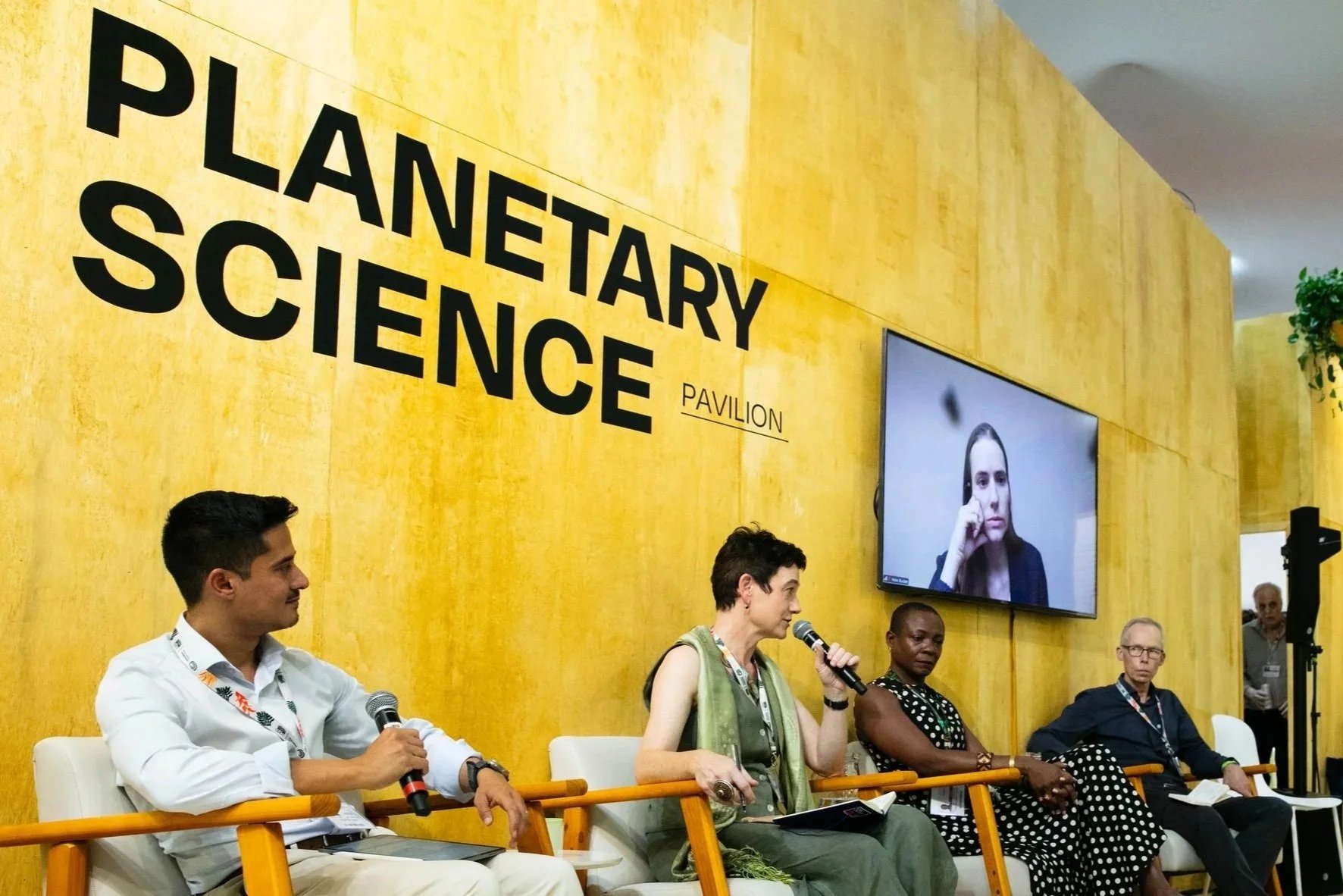
The Planetary Science Pavilion at COP30: Emerging Technology solutions for Planetary Health, launching the World Economic Forum report.
In partnership with the Frontiers Planet Prize and Frontiers, the World Economic Forum pulled together expert networks from its Global Future Council to tap into the technical and scientific expertise of the FPP community. Burdett outlines that the selection process mirrored previous editions, but placed greater emphasis on scale, impact, and risk, ensuring these technologies are evaluated not as standalone innovations, but as part of a broader ecosystem of governance, policy, and finance. Ultimately, this isn’t just about new tools; it’s a make-or-break moment for whether these technologies can be deployed in ways that restore balance to our planetary systems.

Helen Burdett
Head of Planetary Solutions, World Economic Forum
“Imagine over the next year if companies were to start using sensor data instead of self-reported data; hyper-spectral sensors can pick up things that the human eye cannot see e.g. methane; we can measure and report with greater specificity than we get from standard reporting tools. When we look at voluntary reporting and mandatory reporting, we should look to move from tallying up what we think might be there to measuring what is actually happening.”
Conditions for technology development
For these technologies to succeed, certain conditions for development and deployment must be set. As Dunlop explains, “emerging” does not simply mean new to the market, but reflective of solutions that anticipate human and planetary needs amid rapidly changing conditions.
End beneficiaries, such as policymakers, governments, and communities, must be embedded early in the development process, ensuring that solutions are not only technically innovative but capable of delivering meaningful, sustained impact. She also stresses that development must avoid the typical ‘pilot then scale’ pathway. If solutions are too small or experimental at launch, deployment slows, and adoption becomes difficult. These technologies need to be designed for scale from the very beginning.
Diagnosing the problem
Of the ten emerging technologies highlighted in the report, nine focus on addressing the human activities driving planetary degradation. Only one is dedicated to diagnosing the Earth system: the development of a digital twin of the planet. De Gregorio raises a critical question in light of today’s urgency: how much investment should be directed towards Earth system monitoring instead of mitigation technologies?

Johan Rockstrom
Director, Potsdam Institute for Climate Impact Research Chair of the Frontiers Planet Prize Jury of 100
“The mother of real innovation is constraints. The boundaries set by science are shaped by earth observation data - we have the monitoring ability to obtain precise and high-resolution data on soils, biodiversity, marine systems, ice sheets, albedo etc. which are reflections of the state of the earth’s system. We can monitor the entire planet today and quantify our safe boundaries, and this is a tremendous help in accelerating the transition.”
The digital-twin model needs robust funding because we must tighten the uncertainty bands on multiple existential risks. For example, if Atlantic Meridional Overturning Circulation (AMOC) were to collapse, the global consequences would be catastrophic, yet current estimates remain uncertain. Many financial actors dismiss such risks because probability ranges (“1 – 10 % this century”) seem too imprecise to justify large-scale investment. But when the conceivable impact is so severe, from a risk-analysis standpoint, that range should be treated as unacceptably high. To fix these uncertainty ranges, huge investment is needed in earth-system observation and fundamental science to strengthen risk models and enable evidence-based decisions for deploying mitigation and adaptation technologies at both local and planetary scales.
Equitable deployment of technologies
From the perspective of climate-vulnerable nations, Sealy-Thompson draws upon the Bridgetown Initiative, a call for bold and immediate reform of the international financial architecture. Emerging technologies are often trialled in developing countries, with nations too frequently treated as passive “testing grounds” until funding runs out and they are abandoned. Instead, she insists, they must be co-creators. Small island states in particular are on the frontline of climate risk; they should be laboratories for innovation, with sustained investment and genuine partnership.

Tonika Sealy-Thompson
Ambassador of Barbados to Brazil
“We should bring together relevant partners and define a set of projects for climate vulnerable spaces. For each of these projects, the principles of equitable access should be embedded from the beginning, ensuring there are no barriers to finance, co-innovation occurs with local communities, and that monitoring and evaluation processes allow equitable access to outcomes.”
Turning to Rockstrom, who authored the foreword framing the report, De Gregorio queries the risk of emerging technologies being viewed as ‘silver bullets.’ As the Chair of the Jury of 100 for the Frontiers Planet Prize, assessment and scaling pathways for planetary technology breakthroughs are a key deliberation point. It is essential to consider consumption patterns and systems solutions when we lay the tracks for technology to feed into wider system transformations.
Rockstrom points out that technology for abatement exists and is deployable now. There are no excuses for not acting with urgency, particularly when the sustainable solutions for steel, aluminium, fertilizer, cement, and aviation industries are ready. With only a few years to implement these solutions and a few decades to land safely, the only way we can achieve the necessary systems change at scale is through a combination of technology, tried-and-tested policy measures, and behavioural change. The continuation of environmental malpractice is often driven by corruption, populism and undemocratic systems - exploitation continues as though we have infinite resources - 90% of deforestation activity in the Amazon is illegal, so why are people still destroying the life support base for the nation?
If we don't provide effective alternatives, we cannot redirect behaviour. The impact is clear in other case studies: the exponential uptake in solar electrification technologies, especially in African economies, is driven by the fact that renewable energy is cheaper, smarter and more economically interesting. The time for incentives and subsidies has passed; we need to provide evidence-based alternatives with timelines and, therefore, deadlines for implementation, and we must be held accountable on the planetary scale.
The political economy of green transition
Many of the innovations presented demand a systems-thinking approach and a redefinition of core paradigms. Climate KIC has been working with the 112 European Cities committing to carbon neutrality by 2030. Through this experience, Dunlop asserts that this mission is non-trivial. To scale such innovations, cities and regions can use tools like taxation to incentivise responsible deployment. National policies remain insufficient, and alignment between industry interests and regional ambitions is still too fragmented to drive coordinated progress.

Kirsten Dunlop
CEO, Climate-KIC
“This is not just about feeding capital markets some new, bright, shiny thing that still iterates on the same broken system of extractive wealth creation for a very few people, but instead these are solutions that feed a change in human design for life that is balanced inherently and intertwined with the planet. So that means they need to anticipate human needs and an entanglement between human and planetary needs. And they need to anticipate changing conditions: 50-degree heat, very different storm patterns, very different conditions for food and water systems.”
Interoperability is essential. Adopting an open API mindset would greatly strengthen collaboration while ensuring that new technologies are designed to address multiple societal needs. For example, improved access to heating and other basic services has the potential to lift people out of poverty. Dunlop, a key contributor to the modular geothermal energy section of the report, highlights how these technologies work by circulating heat from deep underground into buildings. This challenges the traditional notion of energy as a centralized commodity available at the highest tariff to those who can afford it. Instead, it opens the door to energy democratisation through decentralised and distributed systems, a model that is economically disruptive precisely because it is highly competitive.
The sector often designs technology for those with the highest purchasing power, but that approach limits adoption. Scalability depends as much on access as on technical performance, and these solutions have a real opportunity to expand economic participation and support people in moving out of poverty.
What needs to happen now?
The panel consensus is that we need finance, policy and equity for deployment and scalability and this is a nebulous and non-trivial issue. Scalability must be embedded from the outset. Technologies must be co-designed with the communities who will ultimately use them, ensuring that deployment reflects real needs. The urgency is unmistakable: climate-vulnerable nations are already experiencing severe impacts because planetary systems are deteriorating. Technology will play a role in the pathway back to a safe operating space, and it is our responsibility to use it as a tool for intelligence, mitigation and catalyst for change, but in many cases, this will require systemic and structural change.