

COP30: Award-winning Solutions Restoring Amazonian Ecosystems
This session explored how the Frontiers Planet Prize, the world’s largest science competition in planetary health and Earth system science, is identifying and accelerating breakthrough research with tangible solutions for humanity to live safely within planetary boundaries. Drawing from front-line research that advances planetary boundary science, the discussion examined how to turn breakthrough research into action. This case study demonstrated how science can power equitable transitions: merging ecological restoration with socioeconomic inclusion and offering a blueprint that can be replicated for regions facing similar climate and development challenges. The discussion also reflected on how such integrated science-policy-society models can be scaled through better alignment across research, funding, and governance frameworks, ensuring science leads on impact.
Moderator: Dr Gilbert De Gregorio (Associate Director, Frontiers Planet Prize)
Panellists:
Prof Carlos Peres (Professor, University of East Anglia, Yale University, International Champion, Frontiers Planet Prize 2023)
Dr Joao Vitor Campos-Silva (President, Instituto Juruá, Researcher, National Institute for Amazonian Research)
Prof Mercedes Bustamante (University Vice-President of the Academy for the Minas Gerais and the Central-West Region, Brazilian Academy of Sciences, University of Brasilia)
Dr Mariana Napolitano Ferreira (Science Director, WWF Brazil)
Prof Andy Purvis (Research Leader, Natural History Museum, United Kingdom)
Case Study: Instituto Juruá
Instituto Juruá is a non-profit organisation founded by conservation scientists and local community leaders to promote community-driven natural resource management in the mid-Juruá region of the Amazon. By integrating “scientific research, traditional knowledge and local protagonism,” it funds and guides locally managed initiatives, especially sustainable fisheries and protection of lakes, river beaches and nesting sites, to conserve biodiversity while supporting territorial protection and boosting local livelihoods.
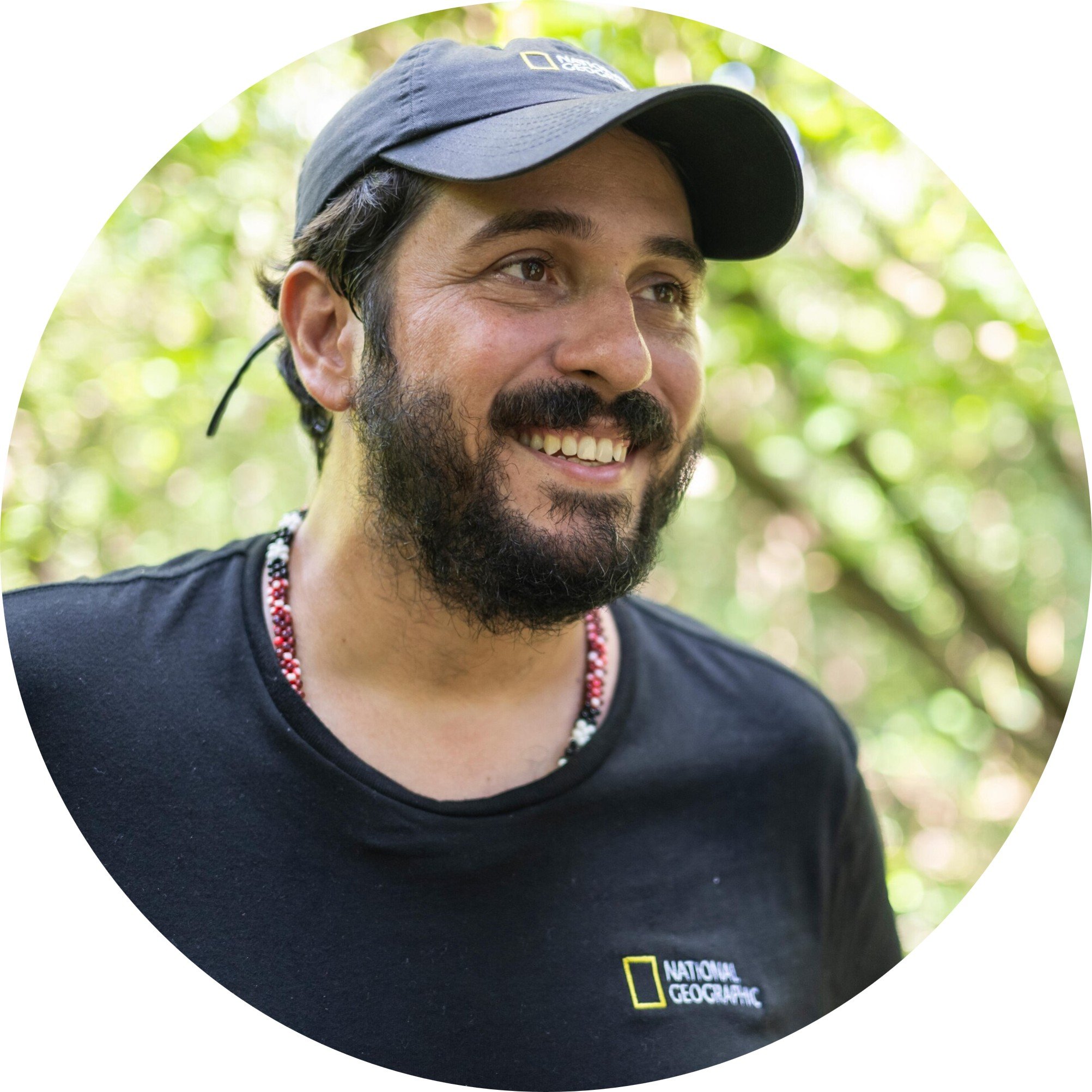
Dr Joao Vitor Campos-Silva
President, Instituto Juruá, Researcher, National Institute for Amazonian Research
“Diversity is the foundation of Amazonia: cultural diversity, biodiversity and ecosystem diversity. We must therefore observe diversity in science in policy too. One of the most important things I’ve learnt is that science is a collective action.”
The institute’s community-driven conservation model has protected 15 million hectares of floodplain forests in the state of Amazonas alone and strengthened 140 communities living within it. The results are striking; in protected lakes, wild Pirarucu populations have surged by almost 500% over 15 years, with some sites now holding up to 50 times more fish than unprotected areas.
This recovery is rooted in a social bioeconomy where biodiversity-based value chains generate income, improve local infrastructure and reinforce territorial protection. Communities negotiate fairer prices, access markets for sustainably harvested fish and invest revenues in schools, solar energy and basic services.
Speaking to the broader scientific picture, Carlos Peres underscored the ecological urgency. Tropical deforestation contributes roughly 15-20% of global greenhouse gas emissions each year while eroding one of the planet’s most important reservoirs of biodiversity. Yet protected areas across the tropics remain severely underfunded and understaffed, leaving them vulnerable to pressures such as agricultural expansion, mining, land grabbing and rising temperatures.

Prof Carlos Peres
Professor, University of East Anglia, Yale University, International Champion, Frontiers Planet Prize 2023
“Local communities have a huge role to play in terms of guarding the last of the wild. They are the legitimate guardians of these wildlands. By empowering local communities, we also fill the power vacuum that would otherwise leave these areas vulnerable to the predatory enterprising sector.”
Conservation science has evolved from top-down strategies to inclusive models that recognise the deep, 12,000-year history of human stewardship in Amazonia. Indigenous and traditional communities have shaped landscapes through sophisticated knowledge systems, management practices and technologies. Lasting conservation requires working with communities as co-designers, not beneficiaries, integrating their knowledge alongside scientific tools. This collaboration also necessitates fair compensation for the work of all involved parties, specifically regarding local communities and indigenous people who historically bear the brunt of conservation and territorial protection while being disenfranchised from and disadvantaged by overarching governance.
Peres also outlines that more rigorous metrics are required to evaluate how successful human-occupied protected areas are. Science now offers tools such as eDNA, iDNA, drone surveys and soundscape monitoring to reveal the full range of species these areas protect. How we define protection depends heavily on the measurement methods we choose, and selecting rigorous, modern techniques could make conservation efforts far more transparent, credible, and therefore scalable.
Evidence to Action for Conservation
Mercedes Bustamanteoutlines that scientific evidence is far more persuasive if it involves clear, localised data, concrete resulting actions and near real-time monitoring. Science must be presented to decision makers in a way that highlights synergies, benefits and links to local economies and social development. This is the most effective way to bridge the gap between research and tangible solutions. In Brazil, satellite monitoring of deforestation has transformed environmental enforcement, enabling municipal, state and federal prosecutors to act urgently to contain and combat deforestation.

Prof Mercedes Bustamante
University Vice-President of the Academy for the Minas Gerais and the Central-West Region, Brazilian Academy of Sciences, University of Brasilia
“We must follow up beyond implementation to identify the successes and shortcomings of conservation outcomes. Science should play a role in adaptive management of the policy cycle.”
Mariana Napolitano Ferreira pointed to the ARPA program as a demonstration of what long-term public policy can achieve. Since 2002, ARPA has supported the implementation of 120 protected areas covering over 60 million hectares. Between 2008 and 2020, the program prevented 260,000 hectares of deforestation, avoiding more than 100 million tons of CO2 emissions. Even during the Bolsonaro administration, when forest loss surged across the Amazon, ARPA areas experienced only 40% of the deforestation that would have been expected without this policy backbone.
She noted that ARPA’s new phase incorporates community-led governance and social bioeconomy principles, drawing on models such as Instituto Juruá. The new strategy will expand local leadership, improve access to energy and digital tools and strengthen the capacity of communities to protect their territories.

Dr Mariana Napolitano Ferreira
Science Director, WWF Brazil
“We must strive to find alternative and innovative solutions with these local communities, and they must be long-term. That is how we are going to make sure the Amazon resists.”
Empowering Communities for Long-Term Stability
Asked about mechanisms that ensure stability and long-term impact for science-based conservation strategies, Peres and Campos-Silva explain that Amazonia operates through a polycentric governance model. This creates environments where local leaders, NGOs, private sector actors, governments and funders collaborate to design strategies that improve livelihoods while ensuring biodiversity protection.
This assertion was echoed by all panellists. By bringing together all partners across the entire stakeholder spectrum, long-term solutions rooted in inclusion and shared ownership can be built. This also provides resilience during political instability. During the previous administration, when environmental policies were dismantled, many communities were left exposed and unsupported. Cooperative governance structures allow them to withstand these pressures and continue safeguarding their territories.
Another central theme was the need to deliver resources directly to the front line. The one million USD awarded by the Frontiers Planet Prize to Peres and Campos-Silva was largely transferred to Instituto Juruá. The panel emphasised that more mechanisms are needed to channel funding directly to communities and avoid it getting tied up in bureaucratic structures. The broader funding landscape remains difficult. The annual global cost of managing tropical protected areas is estimated at seven hundred million USD, yet budgets have remained stagnant for twenty years. Many protected areas still lack the personnel, equipment and operational support required for monitoring, enforcement and implementation.
Across the Brazilian Amazon, there are around 30,000 indigenous, Quilombola and riverine fishing communities. The day-to-day work of environmental protection is led overwhelmingly by these communities, who continue to operate without full recognition or resources. With adequate support in governance, market access and sustainable production, Instituto Juruá has shown how remarkable the biodiversity, social and economic outcomes can be.

Dr Gilbert De Gregorio
Associate Director, Frontiers Planet Prize
“The storytelling dimension of this work is deeply powerful. There is a great socioeconomic wealth that accompanies the environmental conservation aspect of Instituto Juruá.”
This discussion highlighted the importance of research that is grounded in the realities of the communities that are most exposed to ecological risk. It also underscored the need to build durable partnerships, secure stable funding, maintain a clear and forward-looking research agenda, and ensure policy frameworks can adapt across political cycles. The panel ended with a reminder that this work is a marathon. Real transformation takes time, commitment, and a shared sense of purpose. Progress relies on perseverance, inspiration, and the collective focus of science, policy, the private sector, and above all, the communities who are stewarding these landscapes. Ecological restoration and human development are not competing goals; they are deeply interconnected, and together they form a blueprint that can be replicated in other threatened bioregions.