

Human-induced Warming Disrupts Seasonal Flow of Rivers

Hong Wang
Southern University of Science and Technology
DOI: 10.25453/fpprize.32065866
Anthropogenic climate change has influenced global river flow seasonality (Science, 2024
“With highly certain projected warming, further weakening of river flow seasonality is likely. This matters for flood and drought risk, freshwater biodiversity that depends on seasonal flow cues, and how people plan, store, and use water.”
River flow seasonality plays a critical role in the predicted cycle of floods and droughts. A weakening of these peaks and troughs can threaten water security and freshwater biodiversity. However, human activities are altering river flow patterns worldwide, both directly through flow regulations and indirectly through land use change and the impacts of anthropogenic climate change on air temperature, precipitation, soil moisture, and snowmelt regimes. Over two-thirds of the world’s rivers have already been altered by humans, even without considering the indirect impacts from anthropogenic climate change, which is characterized by human-induced alterations in greenhouse gases and aerosols. Yet, until now, evidence suggesting that climate change has had an impact on river flow seasonality has been limited to local studies or has failed to consider the impact of climate change brought about by humans explicitly.
In this study, we used apportionment entropy as a robust measure to assess monthly average river flow volume non-uniformity from 10,120 gauging stations during 1965-2014. The results showed that ~21% (2,134 stations) of long-term river gauging stations exhibit significant alterations in seasonal flow distributions, but two-thirds of these are unrelated to trends in annual mean discharge. In addition, a discernible weakening of river flow seasonality was identified in northern high latitudes (above 50°N).
By comparing data-based reconstructions and state-of-the-art simulations, the study showed that river flow is now far less likely to vary with the seasons in latitudes above 50°N than previously (Figure 1). Climate change detection and attribution analysis further showed that this is directly linked to human-induced climate change at a high confidence level, with direct human intervention, such as reservoirs, human water management, and land-use change, excluded. Possible climatic mechanisms that might drive flow regime dampening under anthropogenic climate change include early snowpack depletion, loss of glacier extent, permafrost loss, increasing proportion of precipitation as rainfall, and shorter freezing periods, interacting with ocean-atmosphere oscillations. Furthermore, no significant trends of precipitation seasonality have been observed in the northern high latitudes, demonstrating that precipitation change cannot account for the results. It is likely that observed rain-snow transition and increasing snowmelt under global warming led to a weakening trend of river flow seasonality in the northern high latitudes. The underlying physics behind this assertion is temperature-driven rather than precipitation-driven.
This study provides the first global evidence of how river flow seasonality is evolving in space and time under human-induced warming and identifies the mechanisms driving these shifts. It highlights the dominant role of anthropogenic warming in altering seasonal river flow across high-latitude regions of the Northern Hemisphere. As temperatures continue to rise, these changes are likely to persist, with implications for flood and drought risk, freshwater biodiversity that depends on seasonal flow cues, and how people plan, store, and use water. Our results can help water managers and conservationists anticipate changing flow regimes and design adaptations that protect both ecosystems and society.
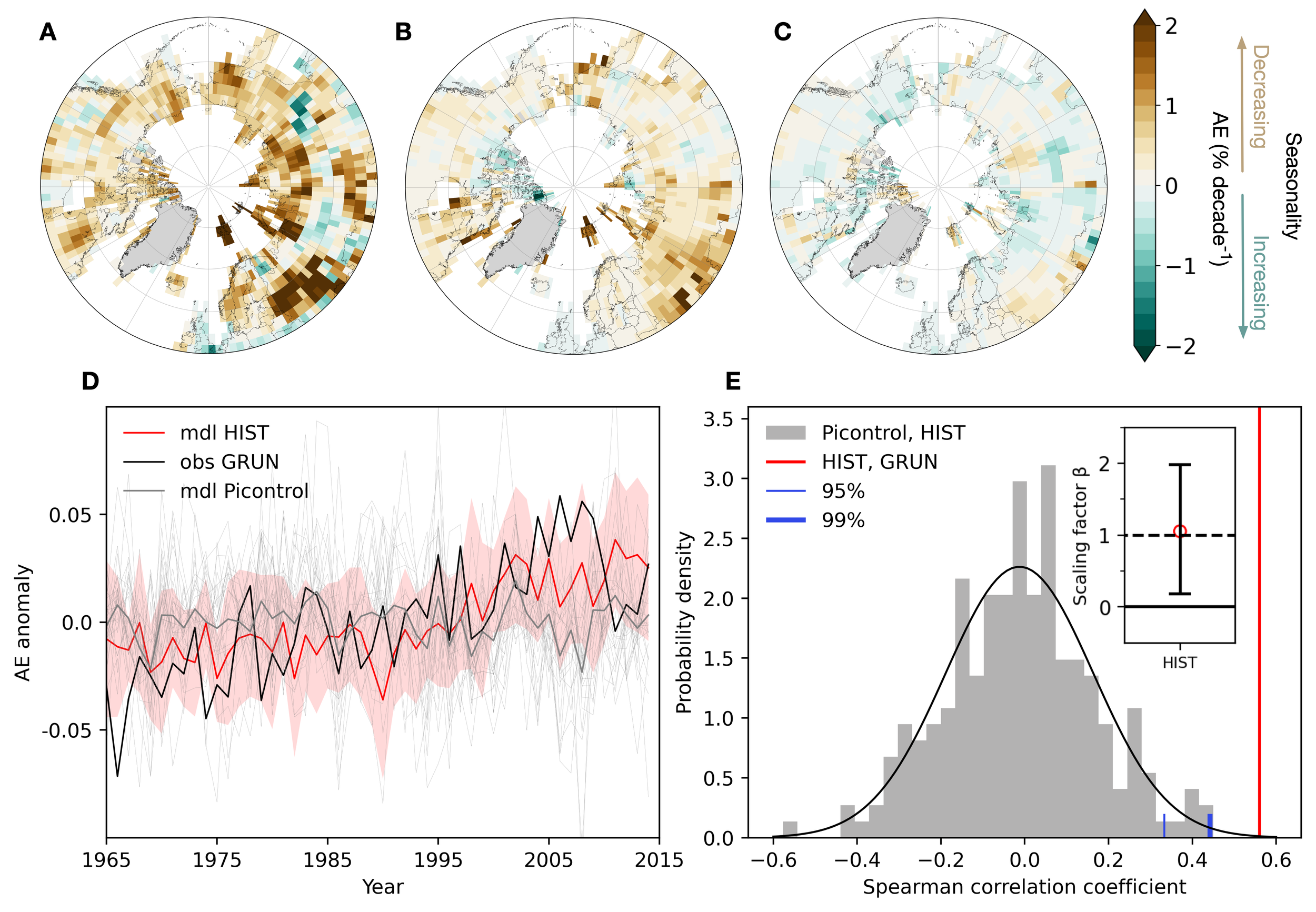
Figure 1. Comparison of apportionment entropy (AE) trends from observation-based reconstructions and global hydrological model simulations for 1965 to 2014 (% decade−1) in the northern high latitudes (above 50°N). (A) Reconstruction from GRUN. (B and C) Simulated changes based on the multimodal mean that account for HWLU under the effects of either HIST (B) or Picontrol (C). (D) Multimodal (mdl) mean time series of annual AE anomalies for HIST&HWLU and Picontrol & HWLU responses and GRUN observations averaged. (E) Correlations of AE anomalies between simulations with and without anthropogenic climate change [corrtemporary (Picontrol, HIST)] or observation-based reconstruction [corrtemporary( HIST, GRUN)]. (Inset) The confidence interval of the scaling factor plot from the optimal fingerprinting method. Source: Wang et al., Science, 2024.
In summary, apportionment entropy can be operationalized as a planetary diagnostic for monitoring hydrological resilience. Embedded within hydrological observatories, apportionment entropy can (1) provide early-warning signals of flow homogenization in vulnerable regions such as the Arctic, the Alps, and the Mekong, and (2) inform adaptive reservoir operations and floodplain restoration to sustain ecologically meaningful seasonality. By providing a consistent, scalable metric, this framework also enables benchmarking across basins and can be integrated into climate adaptation reporting aligned with the Paris Agreement and IPCC assessments, allowing managers to track whether interventions maintain or restore seasonal flow regimes and to compare outcomes across regions.
Addressing weakening flow seasonality through regionally coordinated water management is therefore essential. The apportionment entropy-based climate change detection and attribution framework offers a quantitative basis for prioritizing adaptation investments and targeting actions where climate-driven changes are most likely to undermine freshwater ecosystem resilience and water security. Through international collaboration, this approach can directly inform national and transboundary water policies, providing an operational pathway to maintain hydrological and ecological stability within planetary boundaries.

Figure 2. The full author team. From top left to bottom right: Hong Wang, Junguo Liu (corresponding author), Megan Klaar, Aifang Chen, Lukas Gudmundsson, and Joseph Holden.