

Tree islands in a sea of oil palm foster native biodiversity
Gustavo Brant Paterno
University of Göttingen
Nathaly Guerrero-Ramírez
University of Göttingen
Fabian Brambach
University of Göttingen
Delphine Clara Zemp
University of Neuchâtel
Bambang Irawan
University of Jambi
Leti Sundawati
IPB University
Dirk Hölscher
University of Göttingen
Holger Kreft
University of Göttingen
DOI: 10.25453/fpprize.32065986
Diverse and larger tree islands promote native tree diversity in oil palm landscapes(Science, 2024)
“By reintroducing native forest-associated biodiversity into simplified production systems, monocultures can be transformed into multifunctional, resilient ecosystems.”
When rainforests are converted into monocultures, ecosystems collapse, undermining human well-being and planetary stability. Across Southeast Asia, highly diverse lowland rainforests have been converted into industrial oil palm monocultures (Figure 1A–B). These forests harbor extraordinary biodiversity and endemism, including evolutionarily distinct and ancient plant lineages found nowhere else. Driven by global demand for vegetable oil, millions of hectares have been transformed into simplified production landscapes with sharply reduced biodiversity, ecosystem functions, and services. In Indonesia alone, oil palm plantations now cover roughly 20 million hectares. Oil palm will remain central to global food and commodity systems and to regional economies, and large areas across Southeast Asia, South America, and Africa are considered suitable for further expansion, often overlapping with remaining forests. The urgent challenge, therefore, is not only to prevent further loss but to redesign conventional oil palm landscapes to support planetary health while sustaining production. Building on more than a decade of German–Indonesian interdisciplinary collaboration, our research asks: can we restore native biodiversity and ecosystem functioning within productive oil palm landscapes, while reconciling ecological and socioeconomic needs?
Industrial plantations are structurally homogeneous, dominated by a single non-native crop species (Elaeis guineensis), and intensively managed to suppress natural regeneration. This simplification removes the vegetation structure and ecological interactions that underpin resilience. The impacts cascade across multiple Earth-system processes: contributing to climate change and regional warming through deforestation and carbon emissions; accelerating land-system change by converting forests into simplified production landscapes that increase runoff, flooding, and soil erosion; eroding biosphere integrity as forest-dependent species are lost; and disrupting biogeochemical cycles through nitrogen and phosphorus leaching from intensive fertilizer use. At the same time, the simplified canopy structure creates hotter, drier, and more variable microclimates—conditions that exclude forest species adapted to stable environments and that are harmful to human health. In this way, oil palm landscapes amplify pressures on multiple planetary boundaries simultaneously.
To test a practical approach to bringing biodiversity back into productive plantations, we established tree islands, that is, planted patches of native vegetation within agricultural landscapes. Evidence from our large-scale biodiversity enrichment experiment in Sumatra (EFForTS-BEE) demonstrates that tree islands can rapidly foster regeneration within industrial oil palm landscapes. Six years after establishment, the tree islands hosted 2,788 naturally recruiting woody individuals representing 58 species across 28 plant families. Most species were animal-dispersed, indicating that tree islands help sustain functional seed-dispersal networks even in heavily modified plantation landscapes. Larger and more diverse islands increased functional and phylogenetic diversity locally and across the landscape, potentially strengthening resilience to climate change. Crucially, these biodiversity gains can be achieved while maintaining high yields.
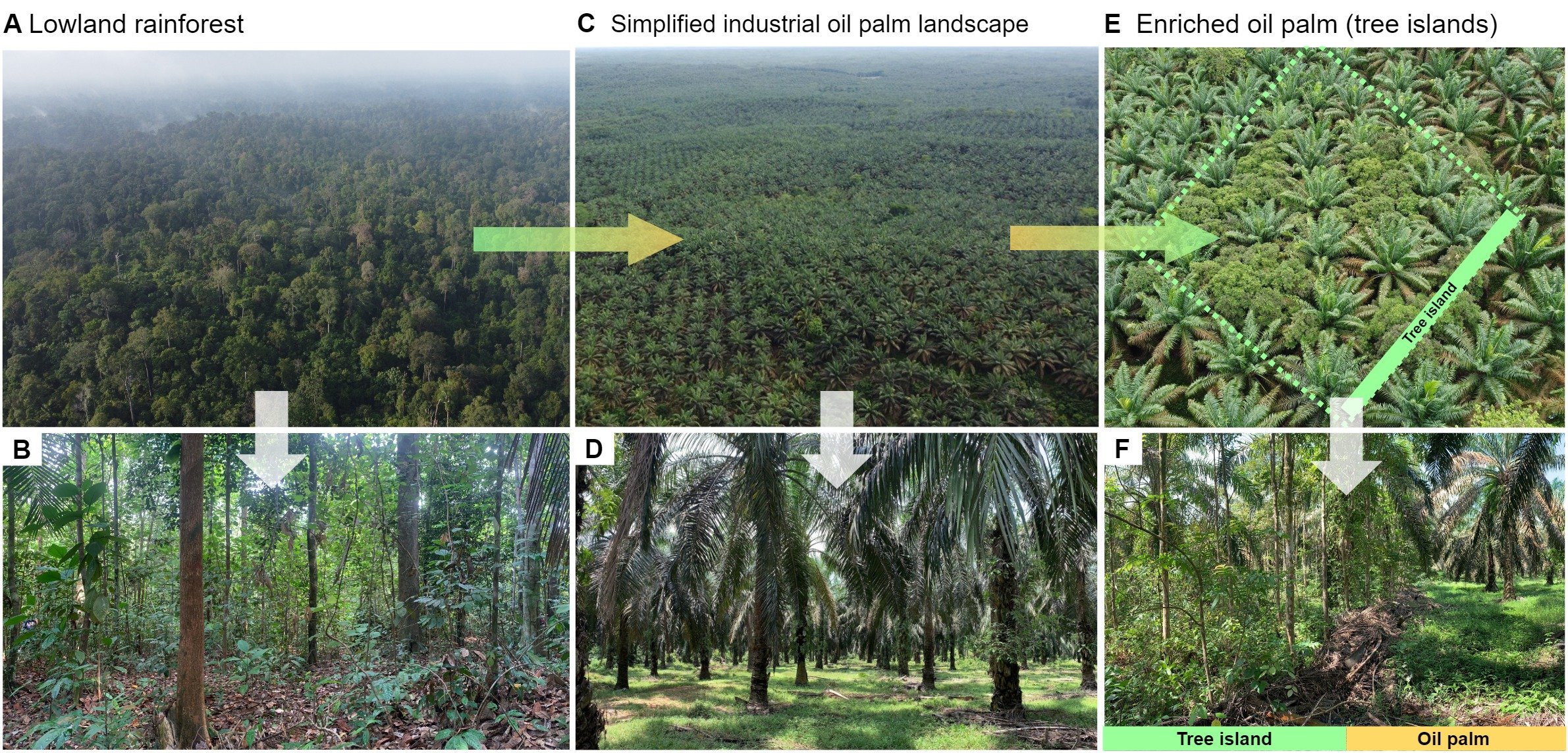
Figure 1. Conversion of lowland rainforest to industrial oil palm landscapes in Sumatra, Indonesia. (A–B) Sumatran tropical lowland rainforests are biologically rich and have a complex canopy and understory home to many forest-adapted plants, animals, and microorganisms (PT Reki Harapan Forest, Jambi Province), as shown from above (A) and from inside (B). (C–D) Corresponding views of a conventional industrial oil palm monoculture (PT Humusindo, Jambi Province) shown from above (C) and from inside (D), characterized by uniform canopy structure and a sparsely vegetated understory dominated by non-native plants. The arrow between panel A and C indicates the transition from forest ecosystems to simplified production systems driven by oil palm expansion. (E–F) A tree island within an oil palm plantation (EFForTS-BEE experiment) shown from above (E) and from inside (F). The arrow between C and E indicates a portfolio of options provided by tree islands in oil palm landscapes. Photos: Gustavo Brant Paterno (B, C, D, F; 2024); Thorge Wintz (A, E; 2024)..
Our research thus provides a practical, scalable approach to reintroduce native forest-associated biodiversity as well as ecological complexity and functioning into oil palm landscapes: embedding native tree islands within industrial oil palm plantations as restoration units (Figure 1E–F). They complement forest protection by reintroducing structure and habitat into production landscapes. Once established, the islands require minimal inputs, i.e., no fertilization and no herbicide application, reducing long-term maintenance costs. Ecologically, they act as regeneration nuclei by attracting seed dispersers, accelerating natural recruitment, and creating more suitable microhabitats for forest-associated species. At the landscape scale, they increase habitat heterogeneity and connectivity, supporting the persistence of forest-associated taxa within productive land.
Tree islands are flexible by design, making them relevant across the oil palm sector and throughout the plantation life cycle. Their size and planted tree diversity and composition, as well as their spatial configuration, can be tailored to local objectives and constraints, offering a portfolio of short- and long-term outcomes depending on management and land-use trajectories. Where oil palm production continues, tree islands enhance local multi-diversity and multifunctionality, and increase landscape-scale biodiversity through species turnover among islands. If plantation management is further improved, for example, through reduced fertilizer inputs and mechanical weeding instead of herbicide application, tree islands can generate spillover benefits by supporting ecosystem services such as pollination, nutrient cycling, and pest and pathogen control. They may also help buffer biodiversity during replanting cycles, mitigating a second wave of losses as plantations are renewed.
Importantly, tree islands can be implemented through multiple complementary pathways. In large-scale industrial plantations, strategically distributed tree islands can be integrated to maximize ecological benefits while maintaining economic viability. In smallholder plantations, small tree islands can act as biodiversity refuges when placed between palm rows or in low-yield areas. Furthermore, native trees can provide multiple direct benefits to people, such as fruits, timber, and latex. Tree islands can also emerge through assisted natural regeneration by designating patches where natural vegetation is allowed to recover, particularly where nearby seed sources are present. In abandoned plantations or where replanting is restricted, tree islands can also catalyze forest recovery through applied nucleation, creating focal habitat that facilitates secondary forest succession.
Our transdisciplinary research and demonstration platform and close collaboration with stakeholders enable coordinated action and rapid dissemination. Certification schemes such as the Roundtable on Sustainable Palm Oil (RSPO) can incorporate tree islands into biodiversity and restoration criteria, supporting uptake across supply chains. Civil society organizations and local universities already show great interest in our work and are essential enablers, providing training, facilitation, financing, and community engagement. Education programs delivered through local universities, together with the trust and long-term expertise of our local research team, are helping build stakeholder networks that support long-term uptake and scaling. For example, several projects in Jambi, Riau, and Borneo are already adopting the tree island approach.
Our work illustrates how solution-oriented science can translate ecological theory into real-world transformation. We advance planetary boundary science by demonstrating a practical intervention inside one of the world’s dominant tropical commodity systems. Tree islands directly strengthen biosphere integrity by restoring taxonomic, functional, and phylogenetic diversity in landscapes otherwise dominated by a single non-native crop. They contribute to climate mitigation by adding woody biomass and increasing carbon storage, buffer microclimatic extremes through increased structural complexity, and improve soil conditions while reducing nutrient leakage into surrounding ecosystems. Together, our work establishes tree islands as a restoration lever across multiple breached planetary boundaries.
Forest protection remains indispensable, yet planetary stability will also depend on redesigning the working landscapes where agricultural production already dominates. Tree islands provide an economically viable and scalable mechanism to bring biodiversity and ecosystem functioning back into oil palm landscapes, a practical step toward regenerative, food-producing landscapes aligned with planetary boundaries.
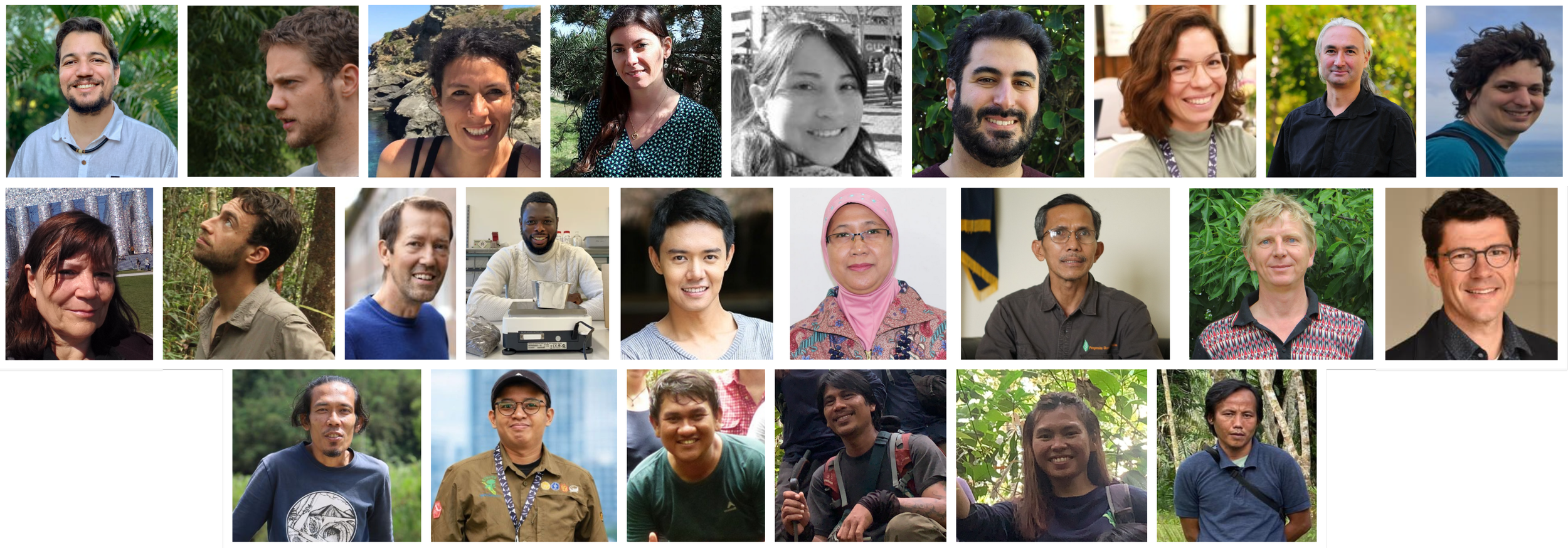
Figure 2. Photographs of all co-authors and the field team for Germany's winning research paper. First two rows from left to right: Gustavo B. Paterno, Fabian Brambach, Nathaly Guerrero-Ramírez, Delphine Clara Zemp, Aiza F. Cantillo, Nicolò Camarretta, Carina C. M. Moura, Oliver Gailing, Johannes Ballauff, Andrea Polle, Michael Schlund, Stefan Erasmi, Najeeb A. Iddris, Watit Khokthong, Leti Sundawati, Bambang Irawan, Dirk Hölscher, Holger Kreft. Bottom row: Juliandi, Dian Muh. Fauzan, Edo Mauliarta, Eduard Januarlin Siahaan, Wisda Tika Plasmasari, and Krisman Hakim Dalimunthe.