

Supramolecular plastics represent a breakthrough in sustainable, circular materials for mitigating threats to the environment posed by the global plastics crisis

Takuzo Aida
The University of Tokyo
DOI: 10.25453/fpprize.32065941
Mechanically strong yet metabolizable supramolecular plastics by desalting upon phase separation (Science, 2025)
“Supramolecular plastics, which are fully closed-loop recyclable, are a promising alternative for tackling plastic waste.”
Plastic is an indispensable material in modern life. Lightweight, durable, versatile, and inexpensive, it underpins everything from medical devices and food packaging to electronics and transportation. Yet the very qualities that make plastics so useful have also made them a global environmental burden.
Because conventional plastics do not readily degrade in nature, they persist in the environment for long periods of time. As they weather, they fragment into microscopic particles known as microplastics, which accumulate in the oceans, rivers, and soils. These particles are now recognized as a serious threat to ecosystems worldwide. Plastic waste that leaks into marine and terrestrial environments also directly harms wildlife: animals ingest it by mistake or become entangled in it, often with fatal consequences, leading to losses in biodiversity. In 2019 alone, 22 million tons of plastic leaked into the environment, including 6.1 million tons that entered rivers, lakes, and the ocean.1 Microplastics are of particular concern because they may enter the human body through the food chain, raising growing concerns about potential health effects.2
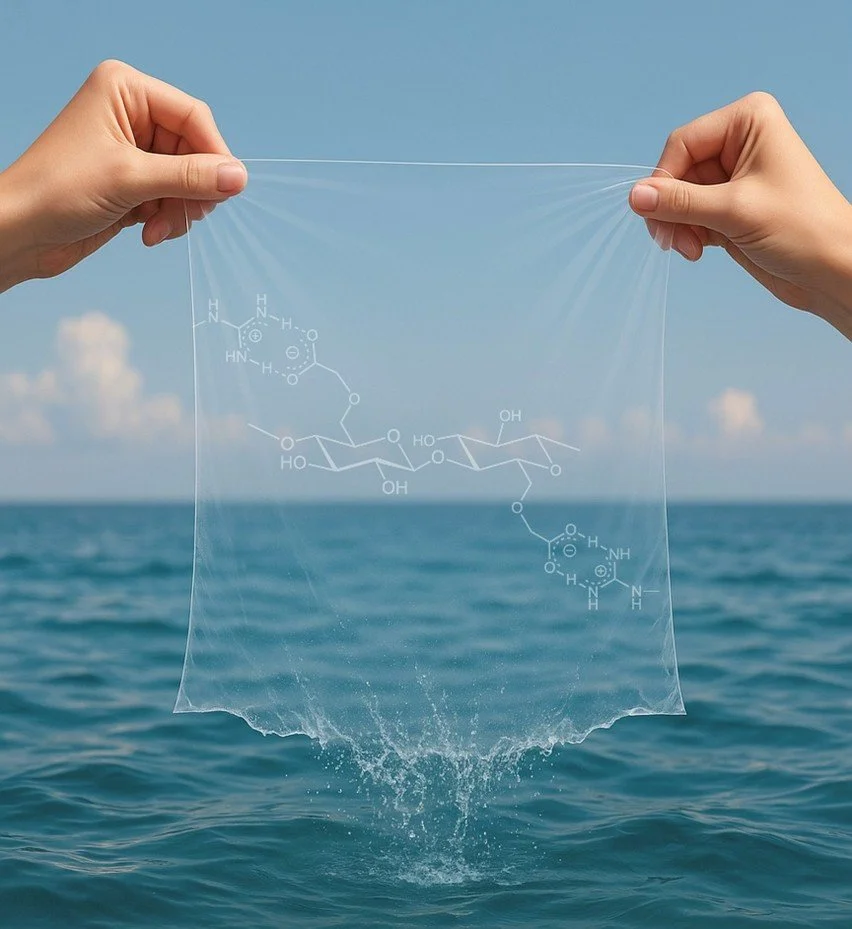
Figure 1. Image of a robust yet marine-metabolized plastic. Schematics originally prepared with a background generated by ChatGPT.
In addition, most plastics are produced from petroleum, and greenhouse gases are emitted at every stage of their life cycle—from production and transportation to incineration at the end of use. In fact, the OECD estimates that plastics generated 1.8 billion tons of greenhouse gas emissions in 2019, equivalent to 3.4% of global greenhouse gas emissions, with roughly 90% of those emissions arising from production and conversion from fossil fuels.1 These emissions contribute to global warming and further accelerate climate change.
Global plastic production has risen from just 2 million tons per year in 1950 to 234 million tons in 2000 and 460 million tons in 2019. By 2019, the cumulative global plastic production had reached 9.5 billion tons. Global plastic waste generation more than doubled from 156 million tons in 2000 to 353 million tons in 2019. Despite the mounting crisis, only about 9% of plastic waste was ultimately recycled in 2019.1 Recycling is costly, and repeated processing generally degrades material quality. Biodegradable plastics have attracted significant attention as possible alternatives,3 however, they face major limitations in mass production, insufficient mechanical strength and durability, and slow degradation.The mass production, mass consumption, and mass disposal of plastics are placing an increasingly severe strain on the planet. The planetary boundary for novel entities, which includes plastics, has been assessed to have already been transgressed,4 and recent work argues that plastic pollution worsens pressures across all nine planetary boundaries.5 Under current policies, plastic use is projected to rise further to 1,231 million tons by 2060, with plastic waste projected to reach 1,014 million tons,6 underscoring the urgency of developing fundamentally new solutions rather than solely waiting for incremental improvements to current materials and processes.
We decided we must act before it’s too late, and as chemists, we endeavored to create an entirely new kind of material. The result was a previously unknown plastic that looks and feels no different from conventional petroleum-based plastics and is sufficiently robust for practical use, yet can be readily decomposed back into its original components when exposed to seawater or soil.7 These original components are non-toxic and can then be metabolized by bacteria. This is a truly unprecedented plastic that offers an entirely different perspective on what an ideal material, one that humanity could live with for the long term, might look like.
This new plastic is produced in a remarkably simple way. When two molecular building blocks, one positively charged and the other negatively charged, are mixed in water, they spontaneously form a strong cross-linked structure and separate from the aqueous phase. Drying this phase-separated material yields the final plastic. The fabrication process requires no toxic organic solvents, no metal catalysts, no heating, no pressurization, and no washing of the product. It represents a scientific and technological platform that could fundamentally transform the conventional landscape of sustainable chemical manufacturing.

Figure 2. Photo of an A4 size cellulose-based tough and flexible plastic film.
The material we developed is a supramolecular polymer, a material formed when molecular building blocks assemble through reversible attractive interactions, much like magnets coming together. Because they are held together by reversible forces, complete molecular-scale recycling without loss of properties is possible. However, these materials have traditionally suffered from poor mechanical properties. I have been working in this field of supramolecular polymers since its early days, advancing its scientific foundations.8 About six years ago, I set the goal of developing an environmentally degradable plastic, with the realization that electrostatic attractions between positively and negatively charged components might allow us to reconcile two seemingly incompatible properties: robustness and simple salt-triggered degradability. Based on this concept, we succeeded in developing a tough plastic that can be broken down by naturally occurring salts.7 Through closed-loop recycling using saltwater, they can be repeatedly disassembled and reconstituted without any loss of quality. Moreover, these supramolecular plastics do not generate microplastics.
More recently, we have extended this strategy to create supramolecular plastics derived from biomass-based feedstocks.9 Considering the use of sustainable building blocks, mild manufacturing process, mechanical properties matching those of traditional plastics, and the opportunities for complete recycling or low-impact degradation, this new class of plastics represents a shining beacon to guide the future of sustainable materials for a new circular economy.
Fortunately, the social response to these new materials has been extraordinarily enthusiastic. More than 600 media outlets have covered this breakthrough, and inquiries have poured in from around the world, including from remote island communities. This has given us a profound sense of hope for the future. Supported financially by private investment funds in the United States and government-backed funds in Japan, we believe that social implementation could be achieved within the next two to three years.
If supramolecular plastics are adopted at a widespread level, it will reduce the anthropogenic burden on critical global processes that regulate the stability and resilience of the Earth. These sustainable materials are poised to reverse the threats to several of the planetary boundaries simultaneously. The ease of production and recycling of supramolecular plastics promises to reduce the consumption of energy and generation of CO2 associated with the manufacturing and incineration of traditional plastics. Furthermore, because of the rapid and complete dissociation of supramolecular plastics into non-toxic, biodegradable molecules, fewer novel entities, such as microplastics, will be released into the environment, rates of water pollution will be reduced, and threats to the biosphere will be mitigated.
At a time when global plastics production has risen from 2 million tons in 1950 to hundreds of millions of tons annually, and when plastics already account for 1.8 billion tons of greenhouse gas emissions per year,1 the world urgently needs fundamentally new materials. While incremental improvements to existing materials are needed, we cannot simply hope and wait. It is our sincere hope that supramolecular plastics, which offer not only environmental degradability but also true materials circularity, could establish a new industrial foundation to fundamentally change the structure of the global plastics problem.
Beyond this challenge, I can already see the outlines of a future society, one that we can hand to our children with confidence and pride.

Fig. 3. Members involved in the prize-winning work. Top row, left to right: Yiren Cheng, Eiji Hirano, Hao Wang, Motonobu Kuwayama, E. W. “Bert” Meijer, Hubiao Huang; bottom row, left to right: Yang Hong, Zhenghong Chen, Kiichi Mizukami, Xingmei Ouyang, Sei Obuse, Hiroyuki Inuzuka.
References
OECD, Global Plastics Outlook: Economic Drivers, Environmental Impacts and Policy Options. 2022, OECD Publishing, Paris, https://doi.org/10.1787/de747aef-en.
Li, Y., Tao, L., Wang, Q., Wang, F., Li, G., Song, M., Potential Health Impact of Microplastics: A Review of Environmental Distribution, Human Exposure, and Toxic Effects. Environ. Health 2023, 1, 249–257.
Kim, M. S., Chang, H., Zheng, L., Yan, Q., Pfleger, B. F., Klier, J., Nelson, K., Majumder, E. L.-W., Huber, G. W., A Review of Biodegradable Plastics: Chemistry, Applications, Properties, and Future Research Needs. Chem. Rev. 2023, 123, 9915–9939.
Planetary Boundaries Science (PBScience), Planetary Health Check 2025. 2025, Potsdam Institute for Climate Impact Research (PIK), Potsdam, Germany, DOI: 10.48485/pik.2025.017.
Villarrubia-Gómez, P., Almroth, B. C., Eriksen, M., Ryberg, M., Cornell, S. E., Plastics pollution exacerbates the impacts of all planetary boundaries. One Earth 2024, 7, 2119–2138.
OECD, Global Plastics Outlook: Policy Scenarios to 2060. 2022, OECD Publishing, Paris, https://doi.org/10.1787/aa1edf33-en.
Cheng, Y., Hirano, E., Wang, H., Kuwayama, M., Meijer, E. W., Huang, H., Aida, T., Mechanically strong yet metabolizable supramolecular plastics by desalting upon phase separation. Science 2024, 386, 875–881.
Aida, T., Meijer, E. W., Stupp, S. I., Functional Supramolecular Polymers. Science 2012, 335, 813–817.
Chen, Z., Hong, Y., Inuzuka, H., Mizukami, K., Aida, T., Supramolecular Ionic Polymerization: Cellulose-Based Supramolecular Plastics with Broadly Tunable Mechanical Properties. J. Am. Chem. Soc. 2025, 147, 44507–44514.