

We need to end the GDP-obsession and put human and planetary wellbeing at the heart of policy

Rutger Hoekstra
Leiden University
Annegeke Jansen
Leiden University
Ranran Wang
Nanjing University
Paul Behrens
Oxford Martin School
DOI: 10.25453/fpprize.32065935
Beyond GDP: a review and conceptual framework for measuring sustainable and inclusive wellbeing (The Lancet Planetary Health, 2024)
“We will never be able to live within planetary boundaries if we do not overcome our obsession with economic growth.”
No policy goal is as clearly defined and universally anchored in society as Gross Domestic Product (GDP), the key indicator of economic activity. This diverts attention from what truly matters: a good life for all within planetary boundaries. Although economic growth is historically correlated with quality of life, GDP’s architect, Simon Kuznets, warned that it fails as a welfare measure. There are other factors that are important to the quality of life, beyond money (GDP). GDP also does not reflect distributional aspects, such as poverty and inequalities of opportunity and outcome. Critically, for the long-term future of this planet and humanity, GDP’s tight coupling with environmental damage makes it a profoundly flawed policy compass.
As global economic growth took off in the 1950s, so did human impact on the Earth System. Climate change projections are outpaced by reality again and again, and human activities have triggered unprecedented species extinction levels, undermining the resilience of our planet. While GDP growth remains our dominant measure of success, we keep rewarding the very dynamics that push us beyond planetary boundaries. Instead, we need metrics that guide policymaking toward human wellbeing within planetary limits, replacing GDP and particularly the growth paradigm, as the foundation of our economic system.
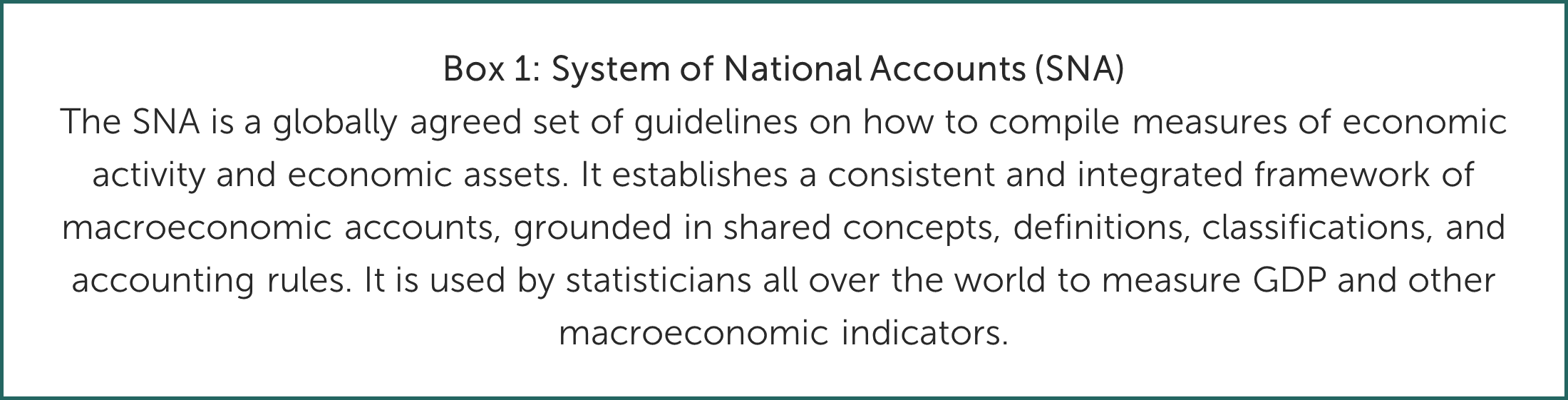
There is increasing recognition that “Beyond GDP” metrics are needed. Alternative metrics, such as the Human Development Index, the Multidimensional Poverty Index, and Life Evaluation, continue to emerge, each claiming conceptual advantages over the others. However, our research shows that widespread adoption depends on more than conceptual merit: it requires an institutionalized, shared language of measurement. The rapid global uptake of GDP only occurred once the System of National Accounts (SNA) provided such a standardized framework (Box 1). Achieving similar convergence and institutionalization in the Beyond GDP field is essential to creating a coherent framework that governments can implement.
Our research promotes convergence of the Beyond GDP field. It provides a unifying scientific foundation and a practical measurement framework built upon lessons from academia, seminal works, and governments that have implemented their own framework. For the scientific foundation, we studied five scientific schools of thought: subjective well-being, welfare economics, needs theories, the capabilities approach, and ecological approaches. Our high-level synthesis of these schools illustrates that well-being measurement should consider three main dimensions: current well-being, the distribution of well-being (inclusion), and well-being in the future (sustainability). Inclusion and sustainability are not to be seen as side considerations – rather, they are foundational principles of progress.
The tripartite framework of sustainable and inclusive wellbeing provides a clear and actionable goal for society. The framing redirects the focus from “beyond GDP” to a more positive frame of inclusive wellbeing within planetary limits. We have also used this tripartite framework to resolve the confusion arising from numerous Beyond GDP alternatives, offering a structured analysis of 65 prominent metrics, delineating their measurement objectives (Figure 1a).
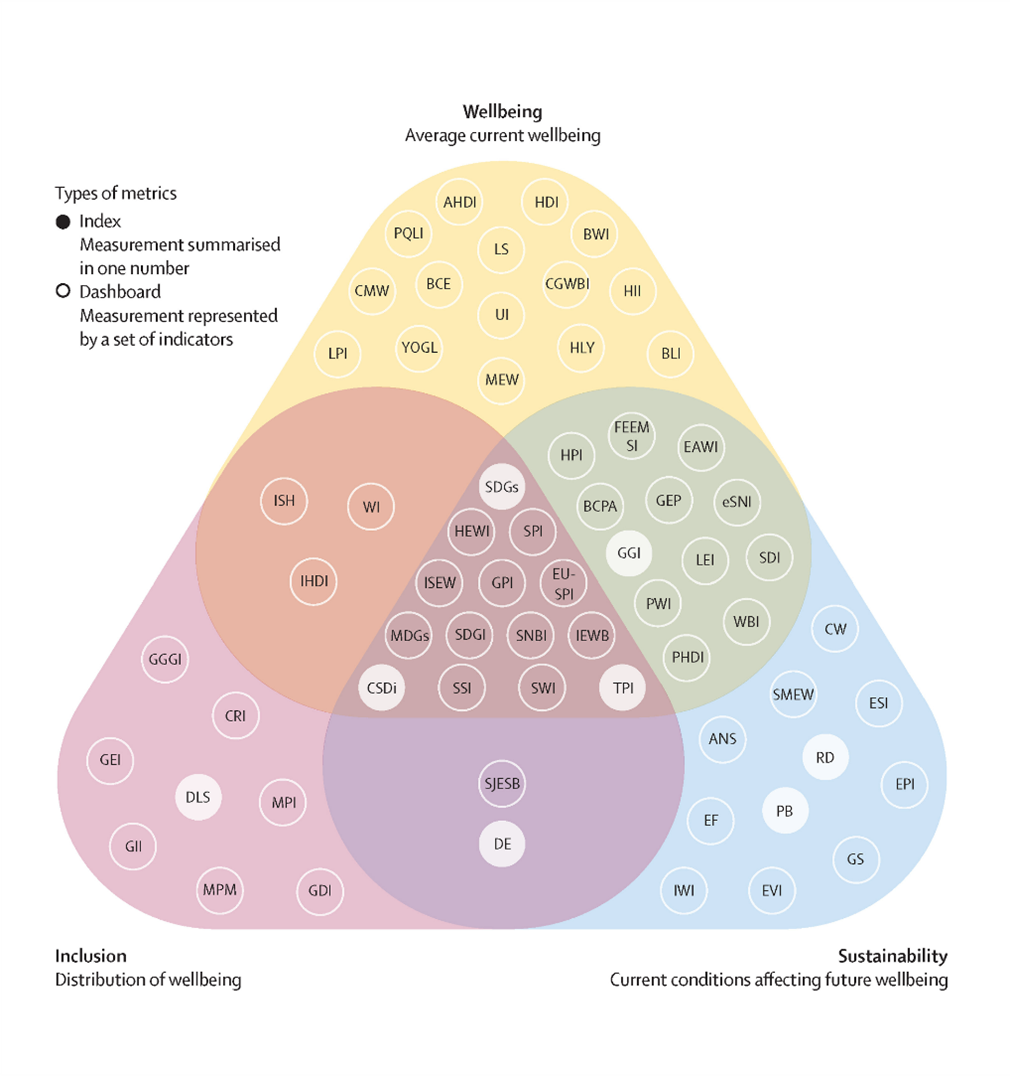
Figure 1. a. Wellbeing, inclusion, and sustainability triangle of Beyond GDP metrics. The triangle shows an overview of 65 Beyond GDP metrics that are plotted based on the dimension they relate to: wellbeing, inclusion, or sustainability, or a combination of two or three of these dimensions. The explanation of the acronyms can be found in the original paper.
We also looked at real-world examples of Beyond GDP frameworks in practice. We identified commonalities and differences for 28 country-specific initiatives to ascertain which characteristics are recommended for integration into an interdisciplinary measurement framework, addressing the divide between scientific proposals and country-specific approaches.
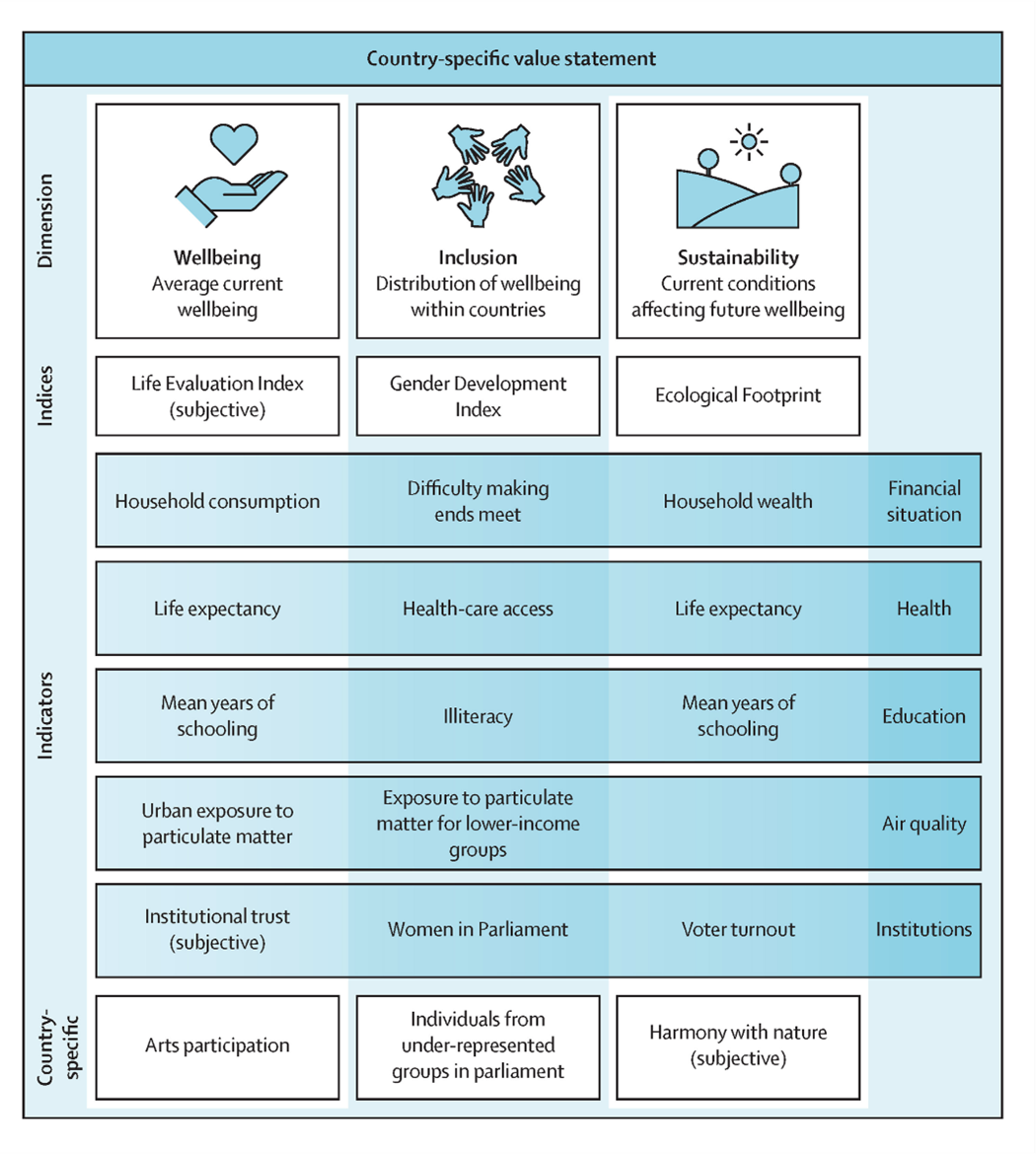
Figure 1. b. An example structure for a dashboard of wellbeing, inclusion, and sustainability. The framework includes a headline space for country-specific value statements to reflect country-specific values. The dashboard is built along two axes: the conceptual dimensions of wellbeing, inclusion, and sustainability on the one hand, and thematic domains. The dashboard includes exemplary indices, subjective and objective indicators and country-specific indicators. Indicators are structured based on their relation to the conceptual and thematic domains. Source: Jansen et al. (2024).
Based on the scientific foundation, seminal works, and country practices, we developed a dashboard structure to measure sustainable and inclusive wellbeing (Figure 1b). First, it enables an interdisciplinary approach by embedding three dimensions (wellbeing, inclusion, and sustainability), as well as objective and subjective indicators to measure development within these dimensions. Second, the framework allows for the inclusion of existing metrics, again structured according to the three dimensions, to elucidate the measurement objective of specific metrics. Last, the dashboard balances the requirements for a standardised and interdisciplinary measurement framework with flexibility to account for country-specific circumstances.
By embedding sustainability as a core dimension, our framework captures trade-offs and synergies that GDP ignores, enabling more meaningful assessments of national success while considering natural limits. Our work strengthens the Beyond GDP movement by stressing the common focus on sustainable and inclusive wellbeing and providing a ready-to-use dashboard linking planetary boundaries to broader socio-economic developments. Garnering over 80 citations (Google Scholar) in 1.5 years, the paper and especially the triangle visual, have gained traction in presentations, documents, and social media (for example, LinkedIn). Notably, the paper has informed the UN High-Level Expert Group on Beyond GDP, which is developing official measurement guidelines to be published in the Spring of 2026, followed by Member States' consultations to stimulate national adoption of the dashboard.
The institutionalization of a measurement framework for sustainable and inclusive well-being is a necessary but not sufficient condition to create a policy paradigm shift. It is important that the indicators composing the dashboard are also used to set targets and drive policy decisions, much like GDP serves as today's compass. By integrating sustainable and inclusive wellbeing indicators into forward-looking projections and models, the dashboard can empower governments to make equitable choices for living well within planetary limits, catalyzing a paradigm shift.

Figure 2. Authors of the article from left to right: Annegeke Jansen, Ranran Wang, Paul Behrens, Rutger Hoekstra