

Uncovering the true severity of ocean acidification to catalyse global action
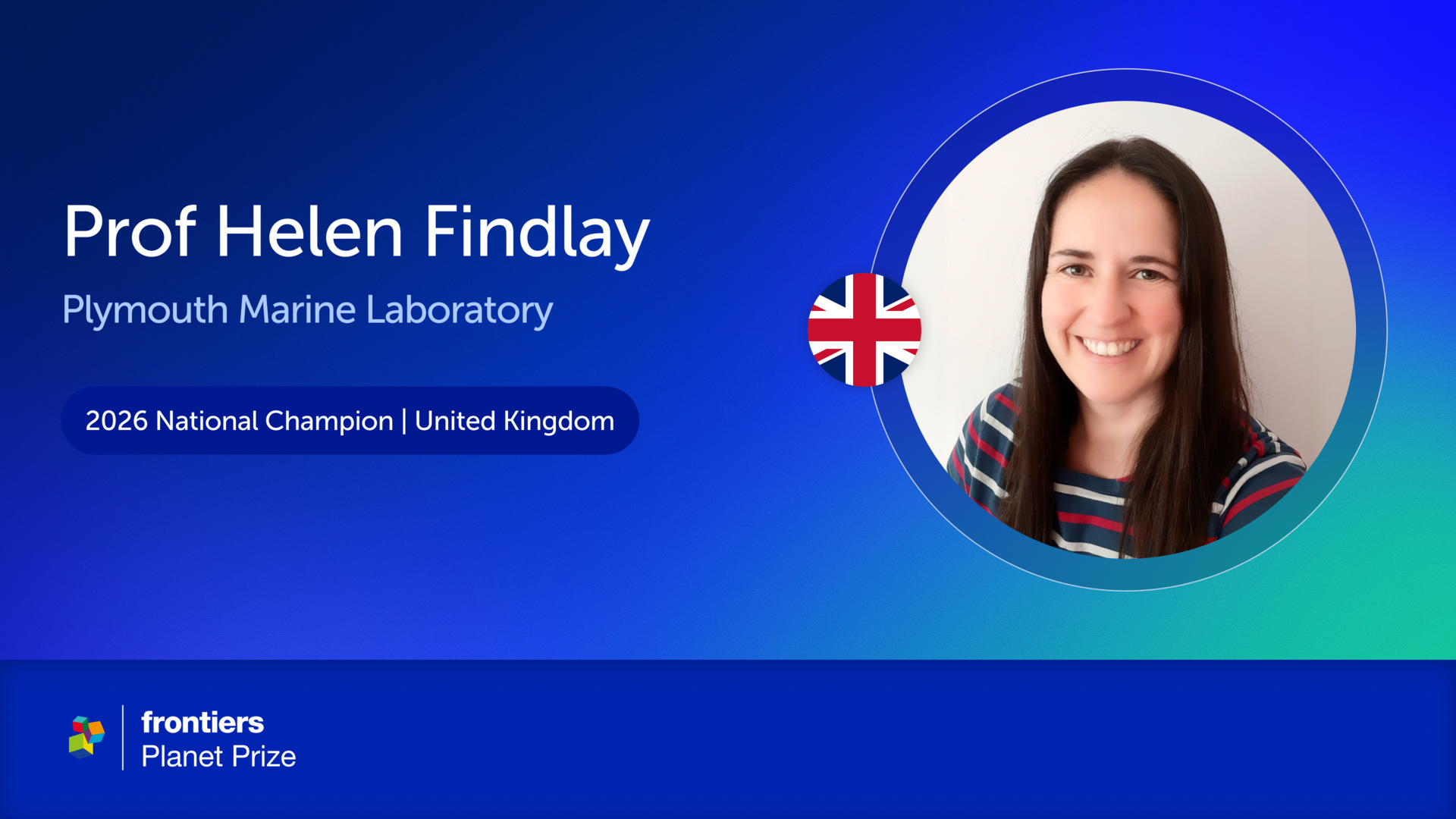
Helen S. Findlay
Plymouth Marine Laboratory
DOI: 10.25453/fpprize.32065839
Ocean Acidification: Another Planetary Boundary Crossed (Global Change Biology, 2025)
“Boundaries must reflect the latest science for society to act on them, and this work is helping to broaden discussions about the ocean’s role in the climate system outside the scientific community.”
Ocean acidification (OA) is no longer a distant risk; it is a present reality that is reshaping the chemistry and biology of our seas, impacting ecosystem functioning and, in turn, feeding back to planetary systems, such as climate regulation. However, as recently as 2024, the planetary boundary for OA had not been deemed to have been breached. In 2025, our research challenged that assumption and established a basis for the revision of the previous safety limit. In doing so, the boundary science can be used to catalyse actionable solutions.
As the ocean absorbs anthropogenic carbon dioxide (CO₂), ocean chemistry is changing, a process known as OA: hydrogen ion concentration is increasing (increasing acidity, or decreasing pH), and carbonate ion concentration is decreasing, resulting in declining saturation states of important carbonate minerals like aragonite (ΩArag) (Caldeira and Wickett, 2003). These chemical changes make it more energetically expensive for marine organisms to thrive, with marine calcifiers deemed to be especially vulnerable (Findlay et al., 2011).
While OA is a global process, high‑latitude and upwelling regions are experiencing the fastest changes (Feely et al., 2023), and impacts on marine organisms are becoming evident. For example, reduced oyster larval production in the northwest U.S. coast hatcheries (Barton et al., 2012), shell dissolution of pteropods (Bednaršek et al., 2014) and impacts on crab larvae (Bednaršek et al., 2020). It was while communicating these issues to policymakers in a polar context that we recognised the importance of capturing these latest findings in the OA planetary boundary (PB).
We revisited the OA boundary by reassessing the assumptions used to define the original boundary and including uncertainty analysis. Then, investigating regional differences, to assess whether vulnerable areas had passed into a “zone of risk”, thus corroborating the increasing field evidence. Finally, extending beyond the surface, recognising that the ocean is a dynamic three-dimensional environment, with many planetary system-relevant processes taking place below the surface.
Our analysis showed that by the year 2020, the global ocean had entered the uncertainty range of the original boundary of a 20% reduction from pre‑industrial ΩArag (Findlay et al., 2025). Crucially, this breach is not uniform: Over 40% of the global surface ocean and up to 60% of the top 200 m had crossed the boundary, with high‑latitude regions already exceeding the boundary on average, and the low‑latitude basins sitting within “marginal” conditions for warm‑water coral growth. These shifts squeeze suitable habitat horizontally and vertically within the water column, with consequences for carbon sequestration, food security, coastal protection, and livelihoods. Our results also indicated that the original boundary is not sufficiently protective when uncertainties, regionality, subsurface ocean, and biological thresholds are considered. We therefore proposed a more conservative boundary of 10% reduction from pre‑industrial ΩArag, in line with the lower limits of the uncertainty assessment. The sobering flip side is that this safer boundary was crossed globally by the early 2000s; a wakeup call for rapid mitigation and targeted adaptation.
While the research focussed on building robust science into the OA PB, the impacts of our findings require us to consider actionable solutions, as well as how to implement them at scale.
The first action must be through mitigation - rapidly cutting CO₂ emissions. The unequivocal driver of OA is the rapid uptake of anthropogenic CO₂ by the oceans. As shown in the paper, only low‑emissions pathways keep parts of the surface ocean within the safe operating space by the end of the century. Intermediate and high‑emissions pathways push 100% of the surface ocean well beyond the boundary, with some areas reaching over 40% decline from pre-industrial conditions. Near‑term policy must prioritize absolute emissions reductions and accelerate deployment of CO₂ removal efforts under robust governance to prevent unintended adverse impacts. OA‑specific benefits should be explicitly recognized in nationally determined contributions and corporate transition plans to strengthen the mitigation case.
The second action should be to consider adaptation through marine management. Our study integrates biological indicators associated with changing chemistry. While further research is required to understand the regional and local nuances of these and other thresholds, these types of indicators can translate into practical design criteria for marine spatial planning, restoration or aquaculture site selection and monitoring. For example, keeping coastal ΩArag > 1.8 may help sustain bivalve aquaculture; maintaining low‑latitude ΩArag > 3.5 may preserve more coral reefs. Governments and NGOs can embed these thresholds into protected area zoning, environmental impact assessment, and fisheries/aquaculture licensing.
A third action should consider how to make vulnerable regions more resilient. Coastal industries can implement proven operational adaptations such as real‑time carbonate chemistry monitoring, selective water intake to avoid corrosive upwelling pulses, buffering hatchery waters, and developing resilient species breeding programs. These approaches, inspired by the U.S. Pacific Northwest’s shellfish industry responses (Barton et al., 2015; Ward et al., 2022) and expanded by the Ocean Acidification Alliance, are immediately transferable to other regions with appropriate capacity‑building and technology transfer.
Finally, OA should be included in targeting conservation efforts, especially considering connectivity and the subsurface. Deep and mesopelagic habitats deserve explicit attention in marine protected areas. Our maps and exceedance statistics can guide siting or rezoning to sustain population connectivity and refugia under tightening chemical constraints. Integrating OA thresholds into the Biodiversity Beyond National Jurisdiction and Kunming‑Montreal Global Biodiversity Framework implementation would align biodiversity commitments with a planetary system risk lens.
Scaling these actions across the globe requires more research to define thresholds and risks at the regional and local scale, but also requires leverage from a range of actors. For instance, within policy, OA‑based targets could be included in ocean chapters of climate plans and biodiversity strategies and/or OA risk assessments could be included in coastal development and fisheries management. Industrial partnerships could establish regional OA observing networks that serve aquaculture and wild fisheries with decision‑grade forecasts. While in the finance sector, concessional finance or blended finance instruments could be tied to OA‑aware design (e.g. coral‑positive reef restoration meeting ΩArag criteria; aquaculture loans contingent on chemistry monitoring and buffering capacity).
Indeed, this research is poised to support tangible impact: By quantifying how much of the ocean has already crossed risk thresholds, decision‑makers can benchmark “how far past the line” we already are, rather than debating whether the line exists. Region‑ and depth‑resolved risk maps provide evidence that monitoring, management, and conservation must extend beyond the surface. These and similar products (e.g. http://acidification.oceandatalab.com/) are openly available for integration into marine spatial planning and environmental reporting. Cross‑validated biological thresholds showcase how complex science can be converted into operational guardrails. The most important near-term activity needed to support action is capacity sharing following efforts of the Global Ocean Acidification Observing Network and others.
Our work advances PB science by moving from a single global number to an uncertainty-based risk envelope. We propagate uncertainties from pre‑industrial CO₂ and model spread to the OA boundary itself, shifting the conversation from a subjective single value to an uncertainty band that better reflects Earth system complexity and the precautionary principle. We move from surface averages to three‑dimensional reality, demonstrating that subsurface layers are already more compromised than the surface, adding critical fidelity to risk assessments and planetary feedback processes. Research is advanced by building in additional biological indicators, providing a template for other potential marine PBs (e.g. deoxygenation (Rose et al., 2024) to integrate ecological functionality into their control variables. While the PB framework does not set out to constrain safe operating space for biology per se, rather it defines processes with planetary scale feedback, ocean biology plays a significant role in climate (Berzaghi et al., 2025), and therefore without a healthy ocean ecosystem the ocean will not continue to act as it has throughout the Holocene to support climate and planetary functions. Finally, advancing the science also advances the impetus for action. Our newly proposed, more protective boundary, while already crossed, can orient mitigation timelines and adaptation priorities. This sharper target aligns closely with the climate goal of limiting global warming to 1.5 °C, especially when considering atmospheric CO₂ concentrations related to these boundaries: average atmospheric CO₂ between 2000 and 2009 was 378 ppm, and is predicted to be ~380 ppm in the year 2100 under the SSP1-1.9 scenario of limiting warming to 1.5 °C. This target, therefore, underscores an urgent need to align climate policy, biodiversity goals, blue economy strategies, and private finance to return Earth’s marine systems to a safer operating space.

The research team: Dr Helen Findlay in the Arctic (left), Dr Richard A Feely (top left), Dr Li-Qing Jiang (top right), Greg Pelletier (bottom left), and Dr Nina Bednaršek (bottom right)
References:
Barton, A., Hales, B., Waldbusser, G.G., Langdon, C., Feelyd, R.A., 2012. The Pacific oyster, Crassostrea gigas, shows negative correlation to naturally elevated carbon dioxide levels: Implications for near-term ocean acidification effects. Limnol. Oceanogr. 57, 698–710. https://doi.org/10.4319/lo.2012.57.3.0698
Barton, A., Waldbusser, G., Feely, R., Weisberg, S., Newton, J., Hales, B., Cudd, S., Eudeline, B., Langdon, C., Jefferds, I., King, T., Suhrbier, A., McLauglin, K., 2015. Impacts of coastal acidification on the Pacific Northwest shellfish industry and adaptation strategies implemented in response. Oceanography 25, 146–159. https://doi.org/10.5670/oceanog.2015.38
Bednaršek, N., Feely, R.A., Beck, M.W., Alin, S.R., Siedlecki, S.A., Calosi, P., Norton, E.L., Saenger, C., Štrus, J., Greeley, D., Nezlin, N.P., Roethler, M., Spicer, J.I., 2020. Exoskeleton dissolution with mechanoreceptor damage in larval Dungeness crab related to severity of present-day ocean acidification vertical gradients.
Bednaršek, N., Tarling, G.A., Bakker, D.C.E., Fielding, S., Feely, R.A., 2014. Dissolution dominating calcification process in polar pteropods close to the point of aragonite undersaturation. PLoS ONE 9, e109183. https://doi.org/10.1371/journal.pone.0109183
Berzaghi, F., Pinti, J., Aumont, O., Maury, O., Cosimano, T., Wisz, M.S., 2025. Global distribution, quantification and valuation of the biological carbon pump. Nat. Clim. Change 15, 385–392. https://doi.org/10.1038/s41558-025-02295-0
Caldeira, K., Wickett, M.E., 2003. Anthropogenic carbon and ocean pH. Nature 425, 365. https://doi.org/10.1038/425365a
Feely, R., NOAA, P., Jiang, L.-Q., Wanninkhof, R., Carter, B., Alin, S., Bednaršek, N., Cosca, C., 2023. Acidification of the global surface ocean: what we have learned from observations. Oceanography 36, 120–129. https://doi.org/10.5670/oceanog.2023.222
Findlay, F.S., Wood, H.L., Kendall, M.A., Spicer, J.I., Twitchett, R.J., Widdicombe, S., 2011. Comparing the impact of high CO2 on calcium carbonate structures in different marine organisms. Mar. Biol. Res. 7, 565–575. https://doi.org/10.1080/17451000.2010.547200
Findlay, H.S., Feely, R.A., Jiang, L.Q., Pelletier, G., Bednaršek, N., 2025. Ocean acidification: another planetary boundary crossed.
Rose, K.C., Ferrer, E.M., Carpenter, S.R., Crowe, S.A., Donelan, S.C., Garçon, V.C., Grégoire, M., Jane, S.F., Leavitt, P.R., Levin, L.A., Oschlies, A., Breitburg, D., 2024. Aquatic deoxygenation as a planetary boundary and key regulator of Earth system stability. Nat. Ecol. Evol. 8, 1400–1406. https://doi.org/10.1038/s41559-024-02448-y
Ward, M., Spalding, A.K., Levine, A., Wolters, E.A., 2022. California shellfish farmers: perceptions of changing ocean conditions and strategies for adaptive capacity.